


Thermal Interface Materials
The dissipation of heat is the key to maintaining longevity and reliability of semiconductor and power devices. Indium Corporation is a leader in the development of both solder and metal-based thermal interface materials (TIM) for a wide variety of applications.


Related Thermal Interface Materials Blog Articles
2021 Space Tech Expo
Come see Indium Corporation's new AuLTRA™75, AuLTRA™ ThInFORMS™, and Thermal Interface Materials at the Space Tech Expo in Long Beach, CA Oct. 6-8, 2021.
Read MoreLiquid Metal Experimentation with Miloš Lazić (Part 4)
We are back today to finish our conversation with Miloš Lazić to find out how he became interested in liquid metals.
Read MoreLiquid Metal Experimentation with Miloš Lazić (Part 3)
Yesterday, in Part 2 of our interview, Miloš mentioned how using a hybrid solid/liquid TIM provides benefits over thermal grease. Today we discuss the challenges of working with liquid metal, and how to address these issues.
Read MoreLiquid Metal Experimentation with Miloš Lazić (Part 2)
In yesterday’s post, Miloš and I discussed what he’s been working on in the lab. Today we answer a question that impacts our TIM customers.
Read MoreLiquid Metal Experimentation with Miloš Lazić (Part 1)
I recently caught up with Miloš, one of our Technical Support Engineers who has taken a special interest in liquid metals. In the lab, Miloš has been experimenting with / creating some of our next-generation liquid-solid hybrid metal materials. Let’s find out what drives his pursuit of the ultimate Thermal Interface Material (TIM).
Read MoreThermal Interface Materials Features & Benefits
All of our thermal interface materials are metal-based, which means they have a very high conductivity as compared to polymer-based thermal interface materials. Indium metal, for example, has a conductivity of 86W/mK and is 4 times softer than lead. Its ductility and thermal conductivity make it ideal as a compressible thermal interface material.
Related Blog Articles
Heat-Spring®
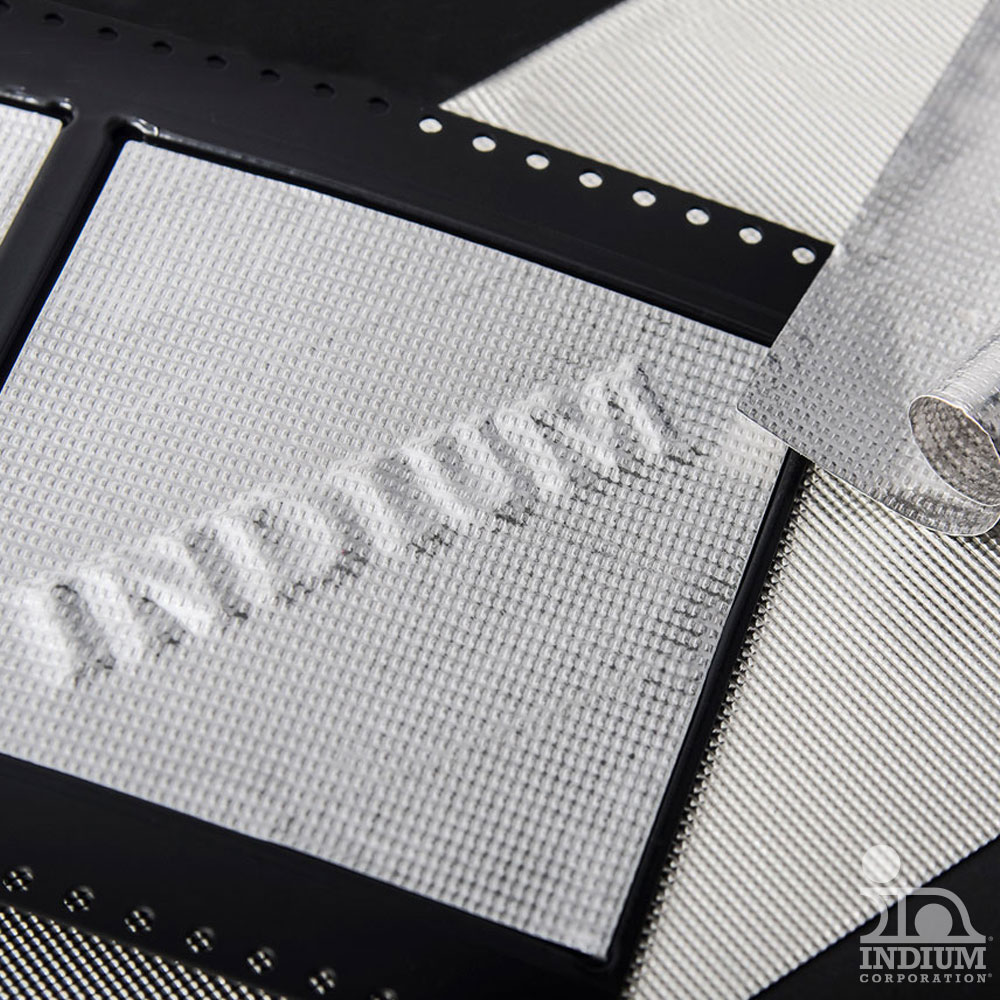
Many applications call for a TIM (thermal interface material) that can easily be placed on a chip, on a lid, or, perhaps, just against a heat source and a cooling solution contact plate. We developed a metal TIM which works as a compressible Interface Solution for such an application. Our pressure range is 35 psi to 100+ psi.
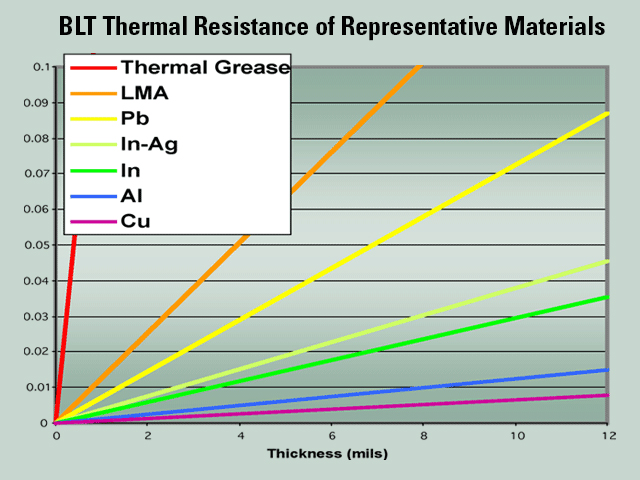
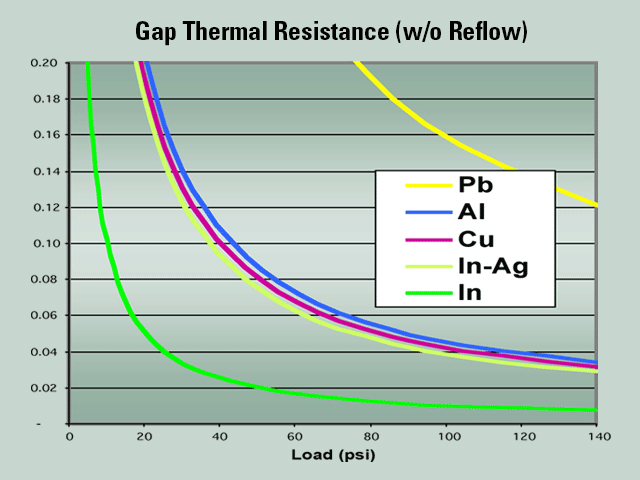
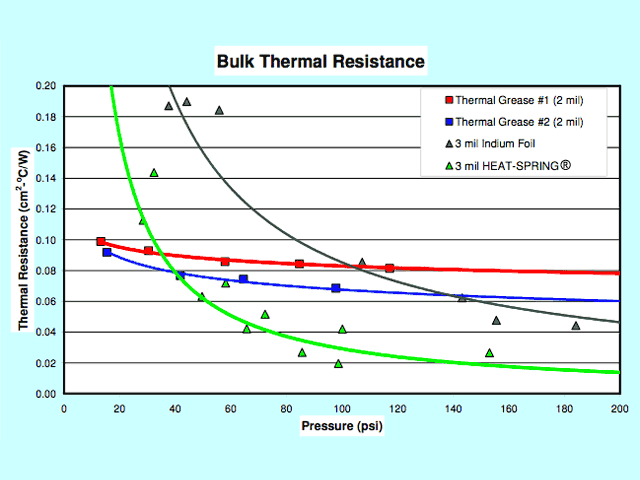
An SMA-TIM (soft metal alloy) made of indium offers uniform thermal resistance at lower applied stresses in compressed interfaces. The malleability of indium minimizes surface resistance and increases heat flow (conductance). Our patented Heat-Spring® technology further reduces the thermal resistance and enhances cooling.
Indium's high-end thermal interface materials deliver superior performance over time. Because SMA-TIM products are made of metal, they cannot experience pump out problems - even under power cycling. Our Heat-Spring® material, which does not contain silicone, conforms to surface disparities, reducing thermal resistance through the life of the TIM. Due to its solid state, the SMA-TIM also does not bake out.
Heat-Spring® for Immersion Cooling
Indium Corporation has designed geometries of Heat-Spring® thermal interface materials to be compatible on Intel Cascade Lake & Ice Lake Processors as well as other processors.
In computing, immersion cooling is a technique that is used for thermal management. The components are “immersed″ in a thermally conductive but dielectric liquid or coolant, and the heat is dissipated by circulating the coolant. In this kind of application, usual polymer TIMs will dissolve in cooling liquids such as these and can create reliability issues. Indium Corporation’s Heat-Spring®—a pure indium*, soft metal thermal interface material—is the perfect solution for this application because of its compressibility and high profile pattern.
*Indium is a sustainable element, and we provide an indium reclaim and recycle program. To learn more about indium, please visit: https://www.indium.com/indium49/
We have proven process expertise and products to recommend for your specific applications. Customization is also available upon request.
m2TIM™
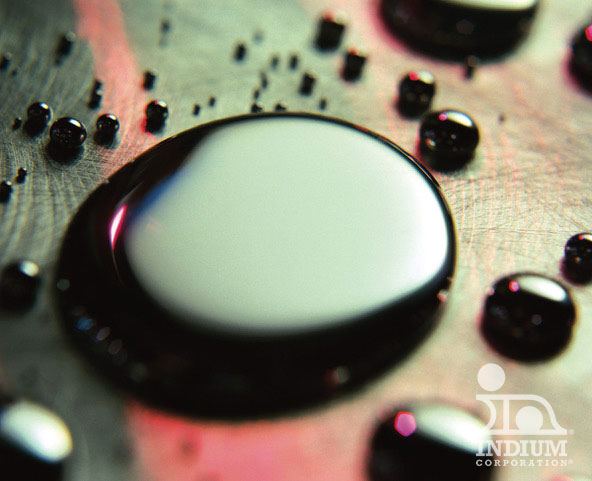
The m2TIM™ is a unique solid/liquid hybrid thermal interface material that combines liquid metal with a solid metal preform to provide reliable thermal conductivity while eliminating the need for a solderable surface.
InGa and InGaSn alloys are liquid at room temperature. Using one of these alloys alone would provide superior thermal conductivity, but would also require containment of the liquid. Introducing a solid solder preform into the process gives you a material that absorbs the liquid and provides the necessary containment without compromising the thermal conductivity. This hybrid approach offers excellent surface wetting and low interfacial resistance, as well as eliminating the risk of pump-out of the liquid alloy.
Metal thermal interface materials (TIMs) are known to have higher isotropic thermal conductivity than any non-metals. Metals conduct heat and electricity with their valence electrons. This very effective conduction mechanism is a property of liquid as well as solid metals and alloys. In addition to the high thermal conductivity of all metals, those in the liquid form will also exhibit low interfacial resistance, ensuring that they can dissipate heat quickly. Liquid metals are used in both TIM1 and TIM2 applications.

Liquid Metal
Our Gallitherm™ portfolio of gallium-based liquid metal solutions draws on the company's more than 60 years of experience in manufacturing gallium-based liquid metals.
Several very low melting point Indalloy® alloys are liquid at room temperature. These gallium-based alloys are finding increased use in various applications as a replacement for toxic mercury, which has a high vapor pressure at room temperature. These alloys have reduced toxicity and lower vapor pressure than mercury.
Excellent Thermal and Electrical Conductivity
Alloy systems that are liquid at room temperature have a high degree of thermal conductivity far superior to ordinary nonmetallic liquids. This results in the use of these materials for specific heat conducting and/or dissipation applications. Other advantages of these liquid alloy systems are their inherent high densities and electrical conductivities.
m2TIM™
m2TIM™ is a unique solid/liquid hybrid approach that combines liquid metal with a solid metal preform to provide reliable thermal conductivity while eliminating the need for a solderable surface. This hybrid approach provides excellent surface wetting and low interfacial resistance, as well as eliminating the risk of pump-out of the liquid alloy.
Extraordinary Wetting Ability to Both Metallic and Non-Metallic Surfaces
These alloys will wet most metallic surfaces once oxides have been sufficiently removed from the substrate surface. However, gallium is very reactive with some metals, even at room temperature. At high temperatures, gallium dissolves most metals, although a number, including Na, K, Au, Mg, Pb, Ni and interestingly Hg, are only slightly soluble at moderate temperatures.1
Gallium and the gallium alloys, like indium, have the ability to wet to many non-metallic surfaces such as glass and quartz. Gently rubbing the gallium alloy into the surface may help induce wetting.
Note: These alloys form a thin dull looking oxide skin that is easily dispersed with mild agitation. The oxide-free surfaces are bright and lustrous.
Applications
Typical applications for these materials include thermostats, switches, barometers, heat transfer systems, and thermal cooling and heating designs. Uniquely, they can be used to conduct heat and/or electricity between non-metallic and metallic surfaces.
Packaging
Alloys are packaged in polyethylene bottles and shipped in accordance with applicable federal regulations.
Storage/Shelf Life
Unopened bottles have a guaranteed one year shelf life. It is recommended that, as the alloy is removed from the bottle, the volume be replaced with dry argon. This will minimize the possibility of oxidation at the surface of the alloy. If the alloy has been stored below its melting point and has solidified, it should be re-melted and thoroughly shaken or mixed before use. Care should be taken in reheating the alloy in the original packaging provided. Temperatures should not exceed 65.6°C.
Please scroll right to view all available information.
| Indalloy® Number |
Liquidus | Solidus | Composition | Density gm/cm3 |
|---|---|---|---|---|
| 46L | 7.6°C | 6.5°C | 61.0Ga/25.0In/13.0Sn/1.0Zn | 6.37 |
| 51 | 10.7°C | 10.7°C | 62.5Ga/21.5In/16.0Sn | 6.50 |
| 60 | 15.7°C | 15.7°C | 75.5Ga/24.5In | 6.35 |
| 77 | 25.0°C | 15.7°C | 95Ga/5In | 6.15 |
| 14 | 29.78°C | 29.78°C | 100Ga | 5.90 |
References
1. K. Wade and A.J. Banister, "The Chemistry of ALUMINUM, GALLIUM, INDIUM, and THALLIUM", Pergamon Texts in Inorganic Chemistry, Vol. 12, 1975.
Solder TIM
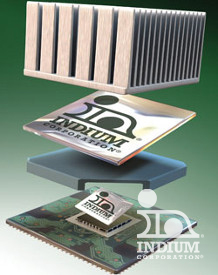
Indium Corporation’s Solder Thermal Interface Materials radically improve:
- Heat dissipation efficiency in electronic devices
- Thermal conductance for high power devices – with densities in excess of 1000 watts
- End-of-life performance at the thermal interface – to avoid failures common with fluidic solutions such as greases
- Portable device battery performance – by reducing thermal resistance and cooling fan size
- Portable device use profile – by reducing heatsink size and mass
- Compliance with RoHS while accommodating step soldering requirements
Indium Corporation has solutions for:
- Telecom
- Medical
- Computing
- Cryogenics
- Semiconductors
- Automotives
- LEDs
- Power Devices
- Photonics
Confidentiality
Indium Corporation recognizes the Importance of confidentiality in the design of thermal interface solutions. As a trusted partner, our engineers will work with you to help you find the right solution for your thermal interface problems. We can help you find the right alloy for performance and the best solder form for ease of assembly.
Applications
Some non-confidential applications include:
- Semiconductor Integrated Circuits
- Power QFNs
- Power device to PCB attach (TO220, etc.)
- Telecom
- Die Attach (Photonics, MOSFETS, etc.)
- LED attach
Products
- AuSn solder
- InPb solders
- Pure Indium
- Informs®
- SnPb solders
- SAC Pb-Free solders
The Indium Advantage
We are committed to understand your unique needs for materials in your product and for your process. No company offers a wider selection of alloys and solder forms to meet your needs. Our variety of alloys, ability to fabricate and package these alloys into easy-to-use forms, and our decades of application knowledge are the core values we bring to your company. Tap into this knowledge-base by calling one of our certified engineers at 1-800-4-INDIUM or email us.