Solder Preforms

Solder Fortification™

A Quick Guide to Solder Preforms

Does your project call for a precise amount of solder? Does the solder need to fit around a pin or fill an irregular shape? If so, then you should consider a Solder Preform.

 Solder preforms come in a variety of shapes and sizes and in virtually all materials offered by the Indium Corporation. Our Applications Engineers have the experience and knowledge to find the perfect configuration for your needs. Contact us today to see if we can make the perfect preform for you! Solder preforms are manufactured shapes of solder or braze metals designed to fit a specific joint configuration. Preforms contain precise and predetermined quantities of an alloy or a pure metal. They have been used in a variety of applications, such as hybrid and discrete component assembly and surface mount technology.

Used in place of traditional solder forms such as wire and ingot, preforms offer advantages for different applications, including versatility, enhanced production economies and flexibility.

An Abundance of Shapes and Sizes

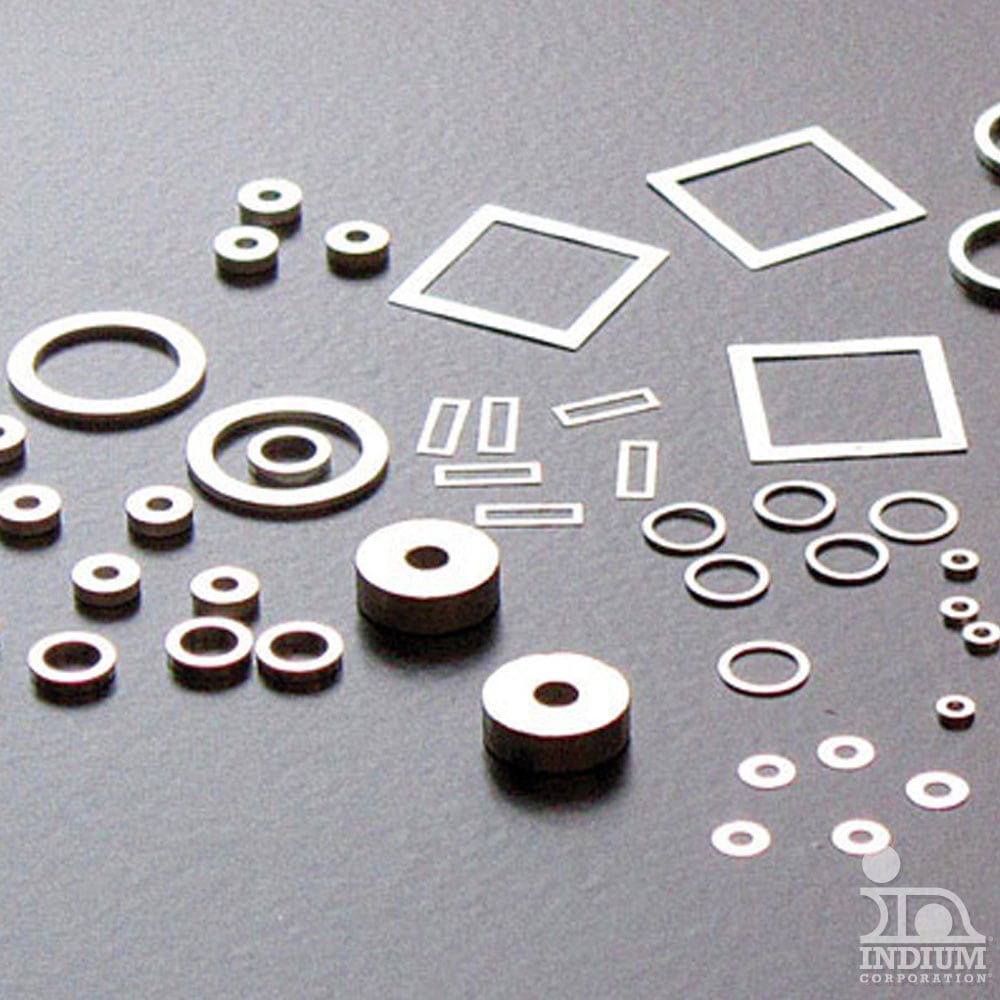
Preforms are available in a number of traditional shapes such as washers, discs, squares and rectangles. Preforms as small as 0.010 in. square or 0.010 in. diameter can be held to tight tolerances for assuring solder volume accuracy. Washers can be produced with similar accuracy with outside diameters down to 0.030 in., or smaller depending on material and thickness specifications (see Table 1 for typical dimensional tolerances). Ribbon is also available for users to produce their own preforms. Precise quantities of solder may also be specified as spheres with diameters as small as 0.003 in. The number of preform shapes is exceeded only by the many ways in which they can be utilized. Die attach preforms are used to attach a silicon, germanium or III-V compound die to a substrate.

 Solder and braze preforms are employed in device assembly and sealing. Preforms are available in more than 220 alloys, with melting temperatures ranging from 47.0¡ to 1063¡. In critical cases, purity can be as high as 99.999 percent.

In addition to their adaptability, preforms greatly enhance production economies. Because the predetermined solder quantity is not dependent on employee judgment, highly skilled operators are not necessary. In turn, this translates to substantial labor savings. Final inspections are simplified because preforms routinely produce uniform solder joints. Pre-placed preforms reliably solder difficult-to-reach areas and can also be coated with a rosin/resin flux to form a complete solder system.

While the initial cost of preforms is somewhat higher than bulk solders, the savings in production more than offset the incremental expense.

The preform configuration is determined by the solder joint location. For example, is there a need to slip the preform over a projection or pin? Is the surface flat? Are clad materials to be joined?

Table 1. Typical Specifications*
Preforms: Minimum size: 0.010 in. diameter or square
Dimensional tolerance: 0.010 in. to 0.060 in. ± 0.001 in.
>0.060 in. ± 0.002 in.
Thickness tolerance: 0.001 in. to 0.002 in. ± 0.0002 in.
0.002 in. to 0.010 in. ± 0.0004 in.
0.010 in. to 0.020 in. ± 0.001 in.
>0.020 in. ± 0.002 in.
Spheres: Minimum diameter: 0.003 in. ± 0.0005in.
*Specifications may vary by alloy.

When designing for preform use, be sure to provide adequate space between materials for proper wetting. A good rule is to allow approximately 0.003 in., and to provide natural boundaries such as grooves, shoulders and troughs to hold the solder in place. This will protect against gravity or capillary action which might cause the solder to flow away from the joint. Since gases expand and contract during heating and cooling cycles, joint designs which might trap air with the preform should be avoided. Trapped gases may produce spatter or cause blow holes in the joint. They even move the solder before solidification. Finally, establish the precise quantity of solder required so the preform can produce the appropriate fillets.

 When specifying preforms, begin by reviewing the melting temperature and surface compatibility of the parts to be joined. Next, consider the physical dimensions required to make the joint. Dimensional over-specification can increase costs. It may be desirable, in some cases, to specify a weight tolerance.

Once you have determined precise weight and dimensional tolerances, it is a good idea to check with Indium Corporation specialists to see if an appropriate die is available from our comprehensive die library. A very slight change in a preform specification may permit a currently available die to be used and, thus, avoid additional costs.

 Remember to study packaging parameters. The larger the quantity of preforms per package, the lower the unit cost. Preform shape, fragility and purity are considerations when selecting the package. Alloys that oxidize easily are frequently packaged in an inert gas such as argon.

The use of preforms with automated placement techniques and mass-production heating methods can reduce costs considerably. Preforms work well with placing equipment, such as rotary and linear vibratory feeders, custom-made vacuum pick-up manifolds and tube-type individual dispensers. Preforms also can be used efficiently with manual assembly techniques such as tweezers and vacuum pickups. Preforms can be soldered with conduction, convection and induction heating, as well as radiation heating. The specific heating method, of course, will be determined by the melting points of the preform, materials in the vicinity, and the configuration of the joint. Heating options for batch processing include ovens, gas and electric furnaces, vapor phase re-flow systems and laser soldering. Infrared radiant-tube ovens can be used with a conveyor system as well. If heat-sensitive materials, such as plastics, are used in the assembly to be soldered, focused infrared lamps, electric hot-air guns or vapor phase soldering are effective heating methods, providing the melting point of a solder is compatible with the substrate temperature.

Conclusion

Finally, it is a good idea to take advantage of the considerable experience available from the experienced team of soldering engineers at the Indium Corporation. We solve thousands of applications problems every year, worldwide. Hence, there is a good chance we will have already developed a solution to your application - whether related to solder alloy selection for an uncommon metalization or an unusual preform shape, size, dimensional tolerance or volume requirement.

Share This