Indium Corporation®
Select an area to search
  • People
    • Technical Support Engineers
    • Sales
    • Human Resources
      • Jobs
      • Community Support
    • Marketing Communications
      • Trade Shows
      • Company News
      • Corporate Awards
      • Technical Milestones
      • Social Media
    • Employee Biographies
    • Corporate
      • About Us
      • Social Responsibility
      • Company News
      • Corporate Awards
      • ISO and ITAR
      • Trade Shows
      • Corporate Literature
    • Bloggers
    • Social Media
    • Facilities
    • Contact Us
  • Products
    • Flux and Epoxy
      • Ball-Attach Flux
      • Epoxy Flux
      • Flip-Chip Flux
      • Flux Pens
      • Flux-Cored Wire
      • Industrial Flux
      • Liquid Tabbing Flux
      • Package-on-Package Flux
      • Tacky Flux
      • TCB and Copper PIllar Flux
      • Wave Flux
      • Wafer Bumping Flux
    • Inorganic Compounds
      • Featured Products
      • Indium Compounds
      • Gallium Compounds
      • Germanium Compounds
    • Metals
      • Indium
      • Gallium
      • Tin
      • Germanium
      • Reclaim and Recycle
    • NanoFoil®
      • Sheets
      • Preforms
      • Powders and Particles
      • Sputtering Target Bonding
    • Reclaim and Recycle
      • Metals Recycling
      • Solder and Solder Dross Recycle Program
    • Solar Assembly Materials
      • Metallization Paste
      • SUNTAB™ PV Ribbon
      • Liquid Tabbing Flux
      • Solders
    • Solder Paste and Powders
      • SACM™
      • Indium8.9 Series
      • Lead-Free
      • Tin-Lead
      • Package-on-Package Paste
      • Low Temp/High Temp
      • Die-Attach
      • Wafer Bumping Paste
      • Solder Fortification®
      • Gold-Based Solder Paste
    • Solders
      • Bismuth Solders
      • Gold Solders
      • Indium Solders
      • Bar Solder
      • Low Temp/High Temp
      • Preforms
      • Ribbon and Foil
      • Solder Fortification®
      • Solder Paste and Powders
      • Solder Research Kits
      • Spheres
      • Tape and Reel Packaging
      • Wire
      • Alloy Chart
    • Thermal Interface Materials
      • Heat-Spring®
      • NanoFoil®
      • Preforms
      • Ribbon and Foil
      • Other
      • Solder TIM
    • Thin-Film Materials
      • Featured Products
      • Sputtering Targets
      • Indium
      • Gallium
      • Others
  • Applications
    • Compounds
      • Batteries
      • Catalysts
      • Fiber Optics
      • LED MOCVD Precursors
      • Optical Lens
      • Reclaim and Recovery
    • Engineered Solder and Alloys
      • Connector Assembly
      • Cryogenic Seals
      • Die-Attach
      • Hermetic Sealing and Pass Throughs
      • IGBT
      • Medical Devices and Electronics
      • Thermal Management
    • LED
    • Low Temperature Alloys
    • Medical Devices and Electronics
    • PCB Assembly
      • Package-on-Package
      • Rework and Touch-Up
      • Solder Fortification®
      • Surface Mount
      • Thermal Management
      • Wave Solder
    • Semiconductor and Advanced Assembly
      • 2.5 and 3D Packages
      • Ball-Attach
      • Die-Attach
      • Flip-Chip
      • Pb-Free Including High Temperature Pb-Free
      • Shock Resistance Solutions
      • SnPb Including High Temperature High Pb
    • Thermal Management
      • Burn-in and Test
      • Concentrated Photovoltaic
      • IGBT
      • RF Power Devices
      • TIM1, TIM1.5, TIM2
    • Thin-Film
      • Thermal Evaporation
      • Plating
      • PV Sputtering Targets
      • Target Bonding
      • PVD Coating Materials
  • Contact Us

Liquid Metal

Home » Products » Thermal Interface Materials » Other » Liquid Metal

  • Liquid Metal
  • Related
    Technical Documents
  • Related
    Blog Posts
Liquid Metal

Introduction

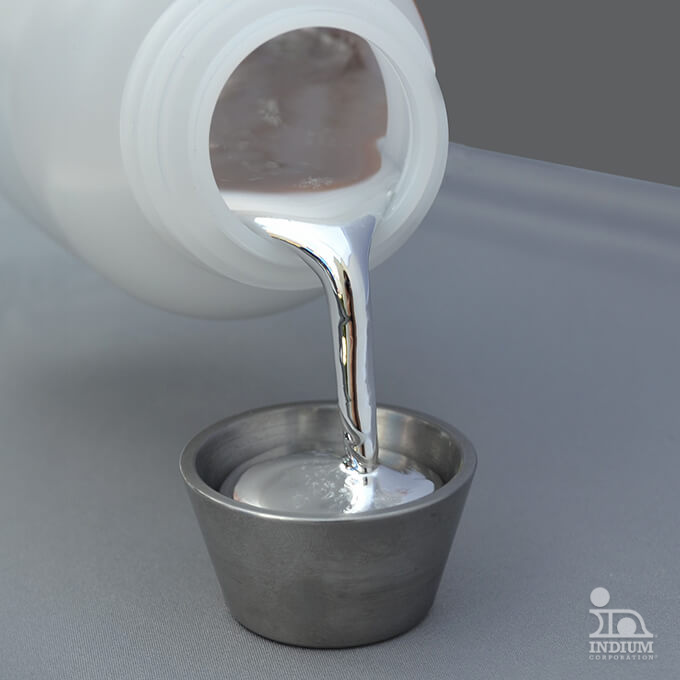
Several very low melting point Indalloy® alloys are liquid at room temperature. These gallium-based alloys are finding increased use in various applications as a replacement for toxic mercury, which has a high vapor pressure at room temperature. These alloys have reduced toxicity and lower vapor pressure than mercury.

Excellent Thermal and Electrical Conductivity

Alloy systems that are liquid at room temperature have a high degree of thermal conductivity far superior to ordinary nonmetallic liquids. This results in the use of these materials for specific heat conducting and/or dissipation applications. Other advantages of these liquid alloy systems are their inherent high densities and electrical conductivities.

Watch the Liquid Metal: Wetting to Different Surfaces Video Watch the Liquid Metals: Wet Glass at Room Temperature Video

Extraordinary Wetting Ability to Both Metallic and Non-Metallic Surfaces

These alloys will wet most metallic surfaces once oxides have been sufficiently removed from the substrate surface. However, gallium is very reactive with some metals, even at room temperature. At high temperatures, gallium dissolves most metals, although a number, including Na, K, Au, Mg, Pb, Ni and interestingly Hg, are only slightly soluble at moderate temperatures.1

Gallium and the gallium alloys, like indium, have the ability to wet to many non-metallic surfaces such as glass and quartz. Gently rubbing the gallium alloy into the surface may help induce wetting.

Note: These alloys form a thin dull looking oxide skin that is easily dispersed with mild agitation. The oxide-free surfaces are bright and lustrous.

Applications

Typical applications for these materials include thermostats, switches, barometers, heat transfer systems, and thermal cooling and heating designs. Uniquely, they can be used to conduct heat and/or electricity between non-metallic and metallic surfaces.

Packaging

Alloys are packaged in polyethylene bottles and shipped in accordance with applicable federal regulations.

Storage/Shelf Life

Unopened bottles have a guaranteed one year shelf life. It is recommended that, as the alloy is removed from the bottle, the volume be replaced with dry argon. This will minimize the possibility of oxidation at the surface of the alloy. If the alloy has been stored below its melting point and has solidified, it should be re-melted and thoroughly shaken or mixed before use. Care should be taken in reheating the alloy in the original packaging provided. Temperatures should not exceed 65.6°C.

Indalloy®
Number
Type Liquidus Solidus Composition Density
lb/in3
Specific Gravity
46L Ordinary Alloy 7.6°C 6.5°C 61.0Ga/25.0In/13.0Sn/1.0Zn 0.2348 6.50
51 Eutectic Alloy 10.7°C 10.7°C 62.5Ga/21.5In/16.0Sn 0.2348 6.50
60 Eutectic Alloy 15.7°C 15.7°C 75.5Ga/24.5In 0.2294 6.35
77 Ordinary Alloy 25.0°C 15.7°C 95Ga/5In 0.2220 6.15
14 Pure Metal 29.78°C 29.78°C 100Ga 0.2131 5.904

References

1. K. Wade and A.J. Banister, "The Chemistry of ALUMINUM, GALLIUM, INDIUM, and THALLIUM", Pergamon Texts in Inorganic Chemistry, Vol. 12, 1975.

Related Markets and Applications

  • Thermal Management

Top Liquid Metal Technical Documents

  • Alloy Sorted By Indalloy® Number (Other)

    Other Document

  • Alloy Sorted by Temperature (Other)

    Other Document

  • Gallium Containing Metals

    MSDS

  • Indalloy® Alloys Liquid at Room Temperature (Letter) (A4)

    Product Data Sheet

Liquid Metal Technical Documents

Whitepapers

No whitepapers to display

Application Notes

No application notes to display

Product Data Sheets

Indalloy® Alloys Liquid at Room Temperature (Letter) (A4)

Material Safety Data Sheets

Gallium Containing Metals

Other Documents

Alloy Sorted By Indalloy® Number (Other)
Alloy Sorted by Temperature (Other)
Pb-Cd Free (Other)
Thermal Resistance (ASTM D5470) (Other)

View All

Thermal Interface Materials Blog Posts

NanoFoil® for CPV Attachment

Thursday, April 18, 2013 by Jim Hisert [view bio]

The attachment of concentrated photovoltaic (CPV) cells is the perfect application for NanoFoil®. Due to the isolated heating during bonding, less stresses are imparted due to coefficient of thermal expansion. Unlike conductive adhesives or epoxies, NanoBonds® are full metal interfaces which…

Coefficient of Thermal Expansion

Monday, April 15, 2013 by Jim Hisert [view bio]

When dealing with bonding, we often mention CTE (Coefficient of Thermal Expansion). This is a very important topic when designing a soldered interface, whether you are choosing materials that will expand and contract at the same rate or bonding alloys or processes that will handle the stress of…

Thermal conductivity of NanoFoil®

Friday, March 08, 2013 by Jim Hisert [view bio]

A NanoBond® acts like a traditional solder bond in many ways. After reaction, the bulk properties of NanoFoil® are similar to that of many solders. To me, the property that is most attractive (since it is similar to that of a solder) is the thermal conductivity of reacted NanoFoil®. Just…

View All Blog Posts

#
Jordan Ross

This page is owned by:

Jordan Ross
Senior Product Manager, Engineered Solders and Thermal Materials
jross@indium.com

INDIUM CORPORATIONwww.indium.comaskus@indium.comPRC +86 (0)512 628 34900SINGAPORE +65 6 268 8678UK +44 (0) 1908 580400USA +1 315 853 4900

From One Engineer to Another®

Indium Corporation — ©1996–2013. All Rights Reserved. | Site Map

Related to Liquid Metal

  • Thermal Management
  • Gallium
  • Indium

Material Safety Data Sheets
Product Data Sheets
ISO and ITAR
Online Store
Tech Team

Connect with Indium

  • LinkedIn
  • Facebook
  • Twitter
  • YouTube
  • Blogger

+ Read our latest posts!

Americas

Utica, Chicago, Clinton
E-Mail: askus@indium.com
Phone: +1 315 853 4900

Asia/Pacific

Singapore, Cheongju
E-Mail: asiapac@indium.com
Phone: +65 6268 8678

China (中国网站)

Suzhou, Shenzhen, Liuzhou
E-Mail: china@indium.com
Phone: +86 (0)512 628 34900

Europe

Milton Keynes, Torino
E-Mail: europe@indium.com
Phone: +44 (0)1908 580400

Regional/Local Sales Support
Technical Service & Support

  • Home
  • Online Store
  • ISO and ITAR
  • Corporate
  • Tech Documents
  • MSDS
  • About Us
  • Jobs