Phil Zarrow: This video is for those in the electronics assembly industry that want to establish when to properly use Cp and Cpk. It includes statistical data and examples.
Dr. Lasky, an important tool for engineers and managers with regard to quality are Cp and Cpk. What can you tell us about these very important metrics?
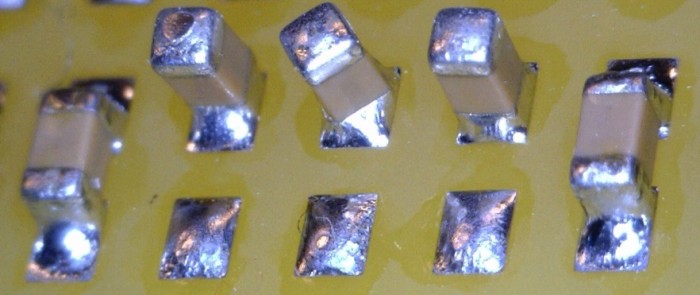
Dr. Ronald C. Lasky: Phil, let's say you order a bunch of 06-03 passives and you want to make sure that the length, which should be 60 mils, is consistent with that. They're not all going to be 60, but you have measured a lot and, of course, you've set a specification. The Cp is a measure of the sharpness of the distribution with respect to the specifications, and Cpk is a little tougher. It's not only "Is the distribution sharp?," but "Is it centered between the two specs?"
One of the things to be aware of is people bragging about Cpks, because, if they are in charge of the specification, you can make the Cp and Cpk be anything you want.
Phil Zarrow: Creative quality accounting. I bet Patty's had some adventures here.
Dr. Ronald C. Lasky: Yes, Patty actually had an adventure with 06-03 passives. She had ordered a bunch of them, and started measuring them, and they were supposed to have a Cpk of 1, verified by the vendor, of course, and she ended up finding out that the Cpk was .67.
She got with the vendor and said "We really want you to improve your process so that you can produce with a Cpk of 1," and the vendor got back with her in just a few days, which is too short to improve the process, right? Patty measured them and found that mathematically they did produce a Cpk of 1, but what had happened is the vendor had sorted them. He had sorted out the ones that were a little bit too long and the ones that were a little too short, and so he had a non-normal distribution, and was calculating with a non-normal distribution.
Cp and Cpk require the distribution to be normal, and a lot of people don't know that. I've heard people that just blindly calculate the numbers and don't check to see if the distribution is normal. Most modern software, like Minitab will check for normality.
Phil Zarrow: The adventure continues.
Dr. Ronald C. Lasky: Yes, there was another case, not too long after, where Patty was looking at some solder paste, and a vendor that usually had given her poor solder paste claimed that they had a Cpk for printing the solder paste, and the volume of the solder paste being the metric that we're looking at. She was surprised, because this company usually provided poor quality stuff. She got a little bit of it, and she measured it and found the Cpk to be more like 1.5.
Her boss said, "This solder paste is cheaper. They seem to have a Cpk of greater than 2, so go visit them." She visited them. She wanted to see the raw data. Always ask to see the raw data. They were very hesitant about this, and, because, what happened is, when you looked at all the data together, the Cpk was just what she was getting – 1.5.
What the person responsible for giving her the data had done is he had broken all the samples up into smaller batches and he found one small batch that had a Cpk of something like 15. He averaged all the Cpks, and all the others being about 1.5, 1.4, and got an average Cpk of 2. That's another thing Patty learned, and she shares with people is that you can't average Cpks. You have to take all of the data together and calculate the data together to get the Cpk that's correct.
Phil Zarrow: Very good. The adventures of Patty and the Professor, true stories and yet very, very good reading and educational, too. Where can we get a copy of it?
Dr. Ronald C. Lasky:If you don't have your copy, you can go to indiumstg.wpenginepowered.com and download a free soft copy of it.
Phil Zarrow: Excellent. Dr. Lasky, thank you very much.
Dr. Ronald C. Lasky: Thank you.
Keywords: indium, Indium Corporation, Dr. Ron Lasky, [email protected], Phil Zarrow, [email protected], passives, specifications, solder paste, solder quality
Lưu Lưu