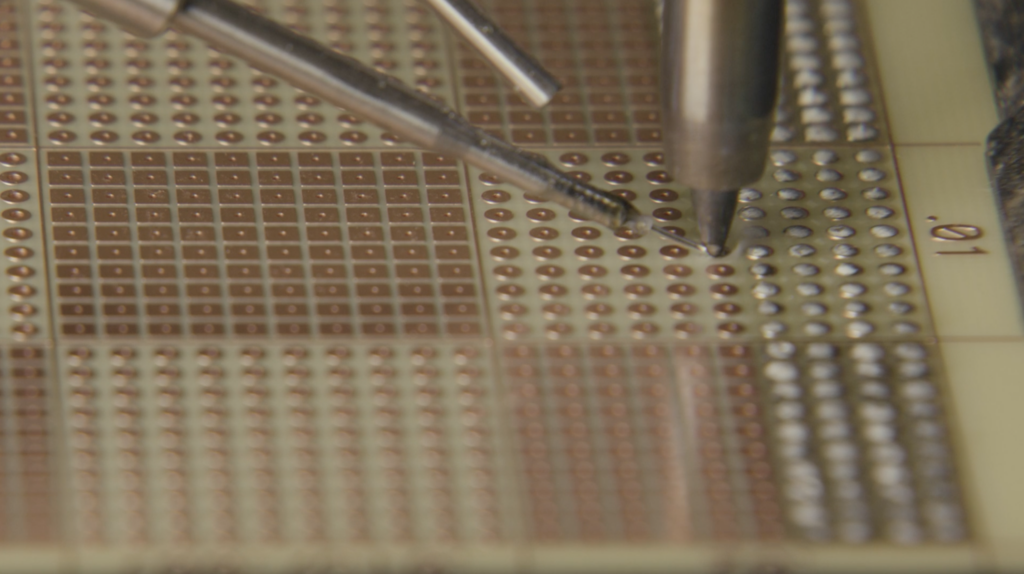
When it comes to electronics reliability, surface insulation resistance (SIR) testing is one of the most important, yet often overlooked, safeguards. Failures in SIR can lead to mission losses, product recalls, or even life-threatening breakdowns in industries where electronics must perform flawlessly. The consequences go beyond financial loss. They touch on safety, trust, and reputation.
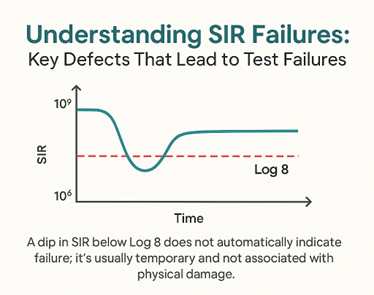
So, what exactly is SIR testing? It measures how well insulating materials resist current leakage when stressed by heat, humidity, and electrical bias. A resistance value of 10⁸ ohms (log 8) or higher is generally considered acceptable. But the good news is that a temporary dip below log 8 doesn’t automatically signal failure. Factors such as duration, recovery, and absence of damage matter. Acceptable ranges can also vary depending on process type. For instance, “no-clean” and water-wash assemblies may behave differently under test conditions.
SIR testing detects electrical leakage. It is important to separate true failure mechanisms from contributing factors. The primary SIR failure mechanism is electrochemical migration, often observed as dendritic growth. Other factors, such as contamination and moisture, enable or accelerate this process. Distinguishing between root causes and failure mechanisms is critical for accurate diagnosis and prevention.
Key Defects
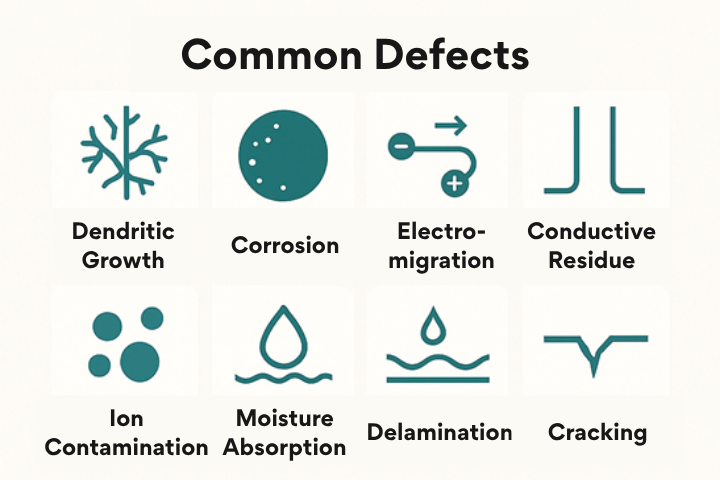
To truly understand and prevent SIR failures, it’s critical to recognize the key defects that cause them and how they can be controlled. These do not represent separate failure mechanisms, but instead enable or accelerate electrochemical migration and dendritic growth.
1. Dendritic Growth
Dendritic growth refers to the formation of conductive metallic filaments between conductors. This usually occurs due to the presence of ionic contamination and moisture under an applied bias. Dendrites can rapidly bridge gaps between conductors, leading to short circuits and catastrophic failure. This is one of the most common and severe forms of SIR failure.
2. Corrosion
Corrosion happens when metal surfaces degrade chemically due to environmental factors, such as moisture, flux residues, or airborne contaminants. Corrosion can reduce the conductive integrity of traces and components, and often accompanies or precedes dendritic growth. It may appear as discoloration or pitting on the PCB surface. This is more commonly associated with water soluble materials or highly corrosive flux chemistries when residues are not properly cleaned.
3. Electrochemical Migration
Electromigration, in the context of SIR, refers to electrochemical migration where metal ions move under bias in the presence of moisture and contamination. This process can lead to unintended conductive paths and is closely related to dendritic growth.
4. Conductive Residue
Leftover residues from flux, cleaning agents, or environmental contaminants can create unintended conductive paths on a PCB. These residues may not be visible, but can significantly reduce surface resistance, especially in humid conditions. This issue is more common with water soluble materials, where proper cleaning can effectively eliminate the risk.
5. Ionic Contamination
Ionic contaminants such as chlorides, bromides, and sulfates can be introduced through flux residues, handling, fabrication materials, or the environment. In the presence of moisture, these species become mobile. This mobility facilitates leakage currents and reduces insulation resistance (SIR). Variations in environmental conditions, particularly humidity fluctuations caused by events such as opening the test chamber, can introduce instability in SIR measurements. Elevated humidity also accelerates electrochemical migration and promotes dendritic growth when mobile ionic species are present.
Care should be taken not to imply that the presence of halides in flux residues inherently poses a reliability risk. Many modern halogenated no-clean flux formulations are designed to produce electrically-benign residues and meet SIR requirements when processed correctly. It is important to distinguish between flux residues and general ionic contamination. Reliability concerns are primarily associated with mobile ionic species from any source. Under conditions of moisture and electrical bias, these species can dissolve and migrate, leading to reduced insulation resistance and electrochemical migration.
6. Moisture Absorption
Moisture can become trapped in materials or under components, reducing insulation resistance and accelerating other failure mechanisms like dendritic growth or corrosion. Proper drying, material selection, and PCB design practices can help minimize moisture-related failures.
7. Cracking or Delamination
Mechanical or thermal stress can cause cracking in the PCB laminate or delamination between layers. These structural issues expose internal surfaces to the environment, making them more susceptible to moisture ingress and ionic migration. This is more associated with board failure rather than a true SIR failure, although it can contribute to one.
Conclusion
Understanding the various defects that can cause SIR failures helps manufacturers and designers implement better process controls, select appropriate materials, and improve PCB layout and cleaning procedures. And remember that monitoring for transient dips in SIR, like a brief drop below log 8, doesn’t have to be a red flag. If the resistance recovers and there’s no visible damage, everything may still be perfectly fine. Persistent or severe drops, however, often signal the presence of electrochemical migration or related contributing factors, such as contamination and moisture.
With proactive detection and smart prevention, you can keep your PCBs reliable and your applications running smoothly.
Industry Case Studies
Why Surface Insulation Resistance (SIR) Testing Matters
SIR testing is far more than a box to check; its real-world impact is significant. Failures can lead to mission losses, product recalls, and safety-critical breakdowns in industries where electronics must perform flawlessly. The true cost goes beyond financial impact: it’s about protecting safety, preserving trust, and safeguarding reputation. In high-reliability sectors such as aerospace, medical, and automotive, SIR testing serves as a frontline defense against hazards, failures, and brand damage. The following are real-world case studies and their impacts.
| Industry | Example/Case | Failure Mode (SIR-related) | Impact/Consequences |
|---|---|---|---|
| Aerospace | Satellite power distribution board contamination | Dendritic growth under humidity bias caused electrical shorts | Loss of satellite function; mission failure valued at >~$200M |
| Aerospace | Avionics control system | Ionic residue lowered insulation resistance, leading to intermittent shorts | In-flight system resets; increased risk to passengers and crew |
| Medical | Pacemaker/defibrillator recall (2,000s, several OEMs) | Residual flux contamination triggered leakage and premature battery drain | Patient safety at risk; recalls cost >~$500M plus lawsuits |
| Medical | Diagnostic monitoring equipment | Corrosion and leakage reduced signal integrity | False/failed readings → misdiagnosis; regulatory non-compliance |
| Automotive | Airbag control modules (well-documented recalls) | Flux residues absorbed moisture → intermittent shorts | Large-scale recalls costing ~billions; safety-critical failure |
| Automotive | EV Battery Management System | Leakage across high-voltage monitoring circuits | Faulty cell balancing, thermal risk, potential fire hazard |
How to Prevent SIR Failures: Best Practices and Solutions
Preventing SIR failure requires a layered defense, with the most practical focus on cleaning and handling controls during PCB assembly.
| Category | Best Practices |
|---|---|
| Cleaning Processes | Remove flux residues using aqueous, semi-aqueous, or vapor degreasing. Verify cleanliness with ion chromatography or ROSE testing. Use automated cleaning systems for consistent results. |
| Handling Precautions | Use gloves to prevent both ionic (salts, flux residues) and non-ionic (oils, greases) contamination. Pack into K-Pak bags to prevent contamination. Store PCBs in dry cabinets or nitrogen-purged enclosures to prevent moisture uptake. Maintain controlled humidity environments in assembly areas. |
FAQs about Surface Insulation Resistance (SIR) Testing
What causes low SIR?
Ionic contamination (flux residues, human oils, environmental pollutants) creates conductive pathways. Under bias and humidity, these cause dendrites, corrosion, and leakage currents, leading to SIR failure.
How does moisture affect SIR?
Moisture dissolves ionic contaminants and accelerates migration. This dramatically lowers insulation resistance and speeds dendrite growth.
Can SIR failures be fixed?
Usually no. Once contamination is trapped, it’s nearly impossible to fix it reliably, especially with conformal coatings. Prevention is far more effective than repair.
How is SIR tested?
Boards are exposed to heat, humidity, and electrical bias while resistance is measured. Failures occur if resistance drops below thresholds (often 1×10⁸ Ω).
Why is SIR important in high-reliability industries?
It is important because even small leakage currents can cause catastrophic failures in aerospace, medical, and automotive electronics where lives depend on reliability.
Key Takeaway
SIR testing isn’t just about compliance, it’s about safety, reliability, and trust. By combining clean processes, careful material selection, and smart design, manufacturers can avoid costly recalls and life-threatening failures. In industries where failure is not an option, SIR testing is your first line of defense. Electrochemical migration, often observed as dendritic growth, is the primary driver of SIR failure. Other factors, such as contamination and moisture, act as contributors that enable or accelerate this process. Proper cleaning, material selection, and process control help prevent costly and dangerous outcomes.