
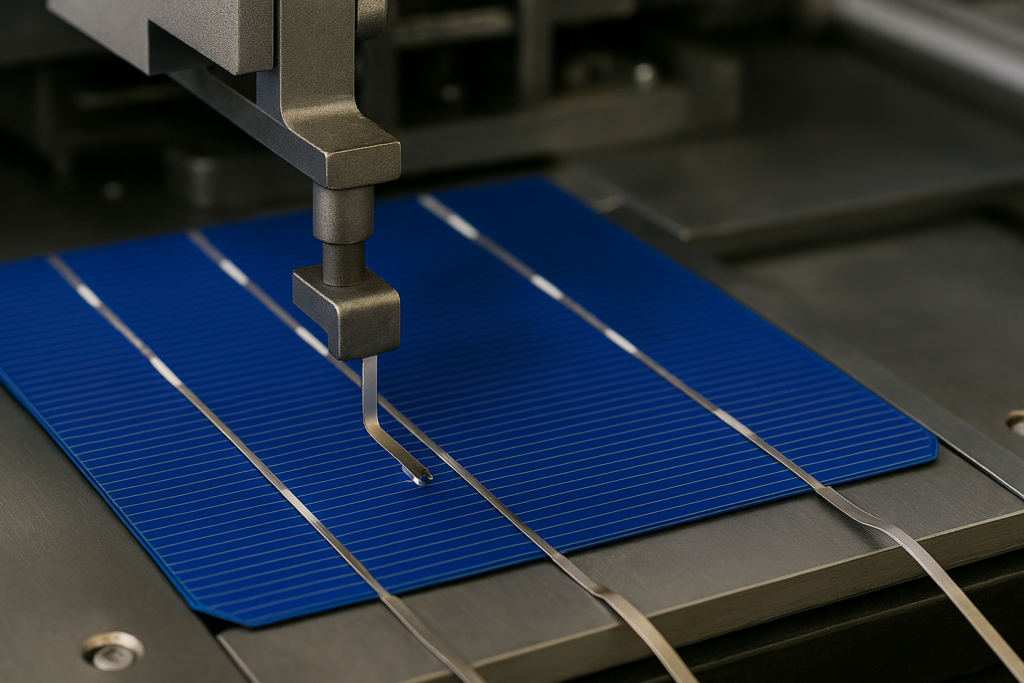
As the solar industry continues to push the boundaries of efficiency and reliability, the materials used in photovoltaic (PV) assembly play a critical role in long-term performance. Indium Corporation, a global leader in materials science, has developed a line of solar fluxes specifically engineered to meet the demanding requirements of solar module manufacturing.
Blended in the USA for Quality and Consistency
Indium Corporation’s solar fluxes are proudly blended in the United States, ensuring consistent quality, traceability, and compliance with domestic manufacturing standards. This localized production supports supply chain reliability and reinforces Indium’s commitment to delivering high-performance materials with minimal variability.
Designed to Minimize Crystallization on Assemblies
One of the key challenges in solar module assembly is crystallization, which can occur when flux residues solidify unevenly on the surface of solar cells or ribbons. This crystallization can interfere with electrical conductivity, compromise adhesion, and ultimately reduce module efficiency. Indium’s solar fluxes are formulated to reduce crystallization, promoting a cleaner, more uniform residue profile. This not only improves the aesthetic and functional quality of the assembly but also enhances long-term reliability by minimizing the risk of corrosion and electrical resistance.
Engineered for Compatibility and Performance
These fluxes are compatible with a wide range of soldering processes and metallization’s, including copper, silver, and tin-coated ribbons. Their low-residue, halogen-free formulations support both manual and automated assembly lines, making them ideal for high-volume solar manufacturing environments.
Conclusion
Indium Corporation’s solar fluxes represent a thoughtful blend of innovation, reliability, and sustainability. By reducing crystallization and ensuring consistent quality through U.S.-based blending, these fluxes help manufacturers build better solar modules—ones that stand the test of time and deliver clean energy more efficiently