여러분,
론 박사님: 다음 몇 개의 포스팅에서는 인디엄 코퍼레이션의 금속 열 인터페이스 재료(TIM) 제품 매니저인 Jon Major와 금속 TIM에 대해 이야기를 나누고자 합니다. Jon, 기술 배경, 인디엄 코퍼레이션과 인연을 맺게 된 계기, TIM에 관심을 갖게 된 계기 등 본인에 대해 소개해 주시겠어요?
Jon: I’ve always been passionate about product development, engineering, materials, and manufacturing. I was fortunate enough to start my career in Silicon Valley, working with the brightest engineers on the planet; I had the opportunity to work on several groundbreaking products, such as the first iPad Air, the first cloud-based smartphone called the “Sidekick”, the first internet connected radio, and several other mobile devices, as well as an IoT platform for connected vehicles.
Jon: Thermal management was always considered at the design level, especially when dealing with consumer products. At Indium Corporation, I have the opportunity to dive deep, not only with the materials themselves, but how they perform with various surfaces, pressures, under varying warpage conditions, and how long they will survive under different use conditions. Our principal thermal engineer recently developed an in-house thermal test vehicle that provides the representative environment for examining performances of thermal interface materials. It’s rather fascinating! I was happy to be a part of a project that enables us to give our customers valuable data on how metal-based TIMs perform under varying conditions.
론 박사님 Jon, 금속 TIM이 필요한 이유와 작동 원리에 대해 간단히 설명해 주시겠어요?
Jon: As integrated circuit (IC) technology has advanced, the amount of heat generated by a high-performance IC is staggering, sometimes exceeding 1,000 watts when the IC is only slightly bigger than an inch (2.5 cm) on one side. The IC typically needs to operate at less than 100°C or its life will be too short. Without TIMs to conduct the heat away from the IC and to the heat-sink, this goal would be impossible.
(그림 1은 방열판으로 열을 전도하기 위해 두 개의 TIM이 있는 IC의 회로도를 보여줍니다.)
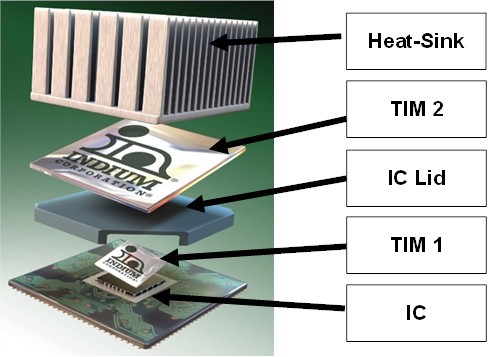
그림 1. TIM1은 IC에서 IC 패키지 뚜껑으로 열을 전달합니다. TIM2는 IC 패키지 덮개에서 방열판으로 열을 전달합니다.
Jon: In the past, polymeric (traditional) TIMs, gels, and other non-metal TIMs were used. In some applications, they are still used today. The most common was thermal grease, which has been used for many decades. Thermal grease has a carrier that is almost like Vaseline®. The carrier is loaded with conductive particles. The thermal grease is then applied where the metal TIMs are in Figure 1. Thermal grease has two shortcomings. One is that its thermal conductivity is not sufficient to meet higher-heat fluxes generated by high performance computing (HPC), AI, accelerated process unit (APU), and graphics processing unit (GPU) trends. The other is that the on/off cycles of electronics can cause “pump-out.” Pump-out occurs when the thermal grease is pumped-out from the space that it occupies to conduct heat away from the IC. With the thermal grease pumped out, it can no longer perform its function.
Jon: This is where metallic based TIMs come in. They can provide the lowest thermal resistance and be customized for package-specific needs. They also do not typically experience pump-out.
Jon: HPC가 발전함에 따라 다이 박형화 및 휨, 열 누화(주변 부품에서 발생하는 열) 및 기타 다양한 설계 문제로 인해 고객이 추가적인 어려움을 겪고 있습니다. 금속 기반 TIM은 이러한 많은 문제를 해결하고 고전력 밀도 애플리케이션에 필요한 성능과 신뢰성을 제공할 수 있기 때문에 수요가 계속 증가하고 있습니다.
Jon: TIM의 주요 목적은 뜨거운 표면에서 차가운 표면으로 열을 전달하는 것이지만, 특정 애플리케이션에서 고려해야 할 다른 속성(예: 조립 용이성, 신뢰성, 지속 가능성)도 있습니다. 금속 기반 TIM은 납땜(리플로), 압축 가능(비리플로), 액체 기반(액체 금속 TIM) 또는 상 변화 TIM으로 분류할 수 있습니다. 상 변화 TIM은 특정 온도에 도달하면 상이 변하도록 설계되었습니다. 향후 포스팅에서 이러한 모든 금속 TIM에 대해 다룰 예정입니다.
Jon: 금속 TIM은 TIM 재료 중 벌크 열전도율이 가장 높다는 장점이 있지만, 벌크 열전도율만이 TIM 선택의 유일한 기준이 아니라는 점을 인식하는 것이 중요합니다. 열 접촉 저항 또는 계면 저항이 일반적으로 전체 TIM 열 저항을 지배합니다. 따라서 열 접촉 저항을 최소화하기 위한 높은 표면 습윤도는 TIM 성능의 중요한 기준입니다.
론 박사님:제가 알기로는TIM1은 보통 납땜 TIM이라고 알고 있습니다. 어떻게 작동하는지 설명해 주시겠어요?
Jon: TIM1 is commonly referred to as the interface between the backside of a die and the underside of an integrated heat spreader (IHS) and component cap. A soldered TIM (sTIM) at this interface is the “Cadillac” of TIMs. Once reflowed, sTIMs form intermetallic bonds that provide low interfacial resistance. Coupled with the fact that metal-based TIMs have high bulk thermal conductivity, the sTIM provides very low overall thermal resistance. sTIMs also mechanically fasten the die and IHS together given there is an intermetallic compound (IMC) formed at the interface. Often, we are asked if the rigidity of the solder joint could cause problems during power cycling. With the proper alloy and process, the sTIM can provide the ductility necessary during the life of the package, so rigidity issues are not a concern.
Jon: There are many process considerations when selecting a sTIM. Indium Corporation has the experience and guidelines to help customers realize the benefits of sTIMs. One of the challenges in assembling TIM1s is voiding during reflow (see Figure 2). Voiding becomes worse after multiple reflows.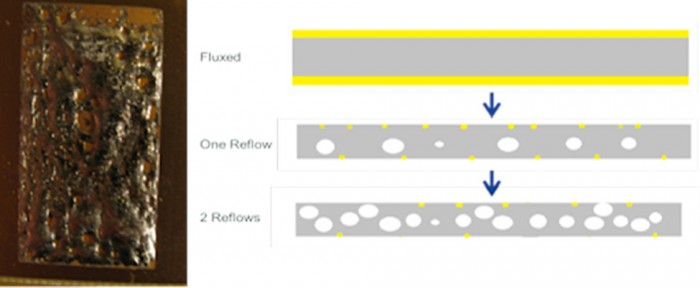
그림 2. TIM1은 칩(또는 다이)과 IHS 사이에 배치됩니다.
Ron 박사: 무효화를 줄이는 데 몇 가지 획기적인 진전이 있었다고 알고 있는데 설명해 주시겠어요?
Jon: 역사적으로 sTIM은 주로 LGA 또는 PGA 스타일 패키지에 사용되었습니다. 이러한 패키지는 한 번 리플로우하여 sTIM을 리플로우했습니다. sTIM이 제공하는 이점 때문에 일반적으로 240~250°C의 최고 온도에서 여러 번의 BGA 리플로우 사이클을 견딜 수 있는 패키지를 위한 최적의 sTIM 재료와 공정을 찾기 위한 노력이 계속되고 있습니다. 후속 리플로우가 진행될 때마다 기존 sTIM 재료는 보이드 성장이 발생하여 열 성능이 저하됩니다.
(InAg 합금은 순수 인듐에 비해 상당한 개선 효과를 보여 후속 리플로우에서 보이드 성장을 줄입니다. 그림 3 참조)
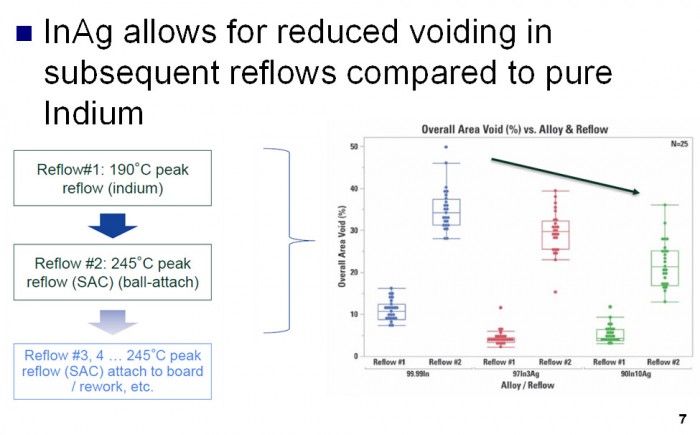
그림 3. InAg TIM1은 In TIM1에 비해 보이드가 현저히 감소합니다.
Jon: However, there are trade-offs to adding Ag to the solder joint. More Ag also means lower bulk thermal conductivity and a more rigid solder joint leading to reduced mechanical reliability. There is significant research underway to understand how different compositions of InAg wet to various surfaces and how they perform during reliability testing. High surface wetting, to minimize thermal contact resistance, is a critical TIM performance criterion. In addition, poor wetting can result in higher voiding, also leading to poor thermal performance. With the proper alloys selection, flux and process considerations sTIM can be adopted in Flip Chips BGA(FCBGA)style packages that will undergo multiple reflow cycles (see Figure 4).
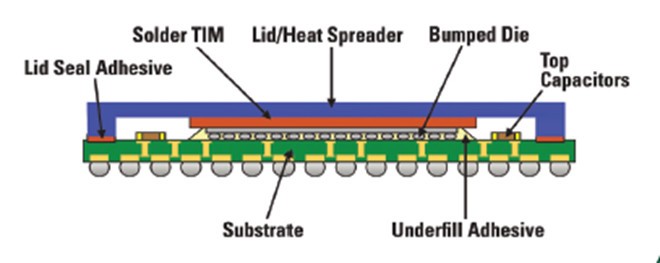
그림 4. InAg sTIM은 FCBGA에 적합합니다.
여러분,
mTIMS1.5에 대한 다음 포스팅을 기대해 주세요!
건배,
론 박사