乡亲们
Dr. Ron: For my next several posts, I would like to chat with Indium Corporation’s metal thermal interface materials (TIMs) Product Manager, Jon Major, about metal TIMs. Jon, can you tell us a bit about yourself; your technical background, how you got connected to Indium Corporation, how you became interested in TIMs etc.?
Jon: I’ve always been passionate about product development, engineering, materials, and manufacturing. I was fortunate enough to start my career in Silicon Valley, working with the brightest engineers on the planet; I had the opportunity to work on several groundbreaking products, such as the first iPad Air, the first cloud-based smartphone called the “Sidekick”, the first internet connected radio, and several other mobile devices, as well as an IoT platform for connected vehicles.
Jon: Thermal management was always considered at the design level, especially when dealing with consumer products. At Indium Corporation, I have the opportunity to dive deep, not only with the materials themselves, but how they perform with various surfaces, pressures, under varying warpage conditions, and how long they will survive under different use conditions. Our principal thermal engineer recently developed an in-house thermal test vehicle that provides the representative environment for examining performances of thermal interface materials. It’s rather fascinating! I was happy to be a part of a project that enables us to give our customers valuable data on how metal-based TIMs perform under varying conditions.
罗恩博士 乔恩,你能简要解释一下为什么需要金属 TIMs 以及它们的工作原理吗?
Jon: As integrated circuit (IC) technology has advanced, the amount of heat generated by a high-performance IC is staggering, sometimes exceeding 1,000 watts when the IC is only slightly bigger than an inch (2.5 cm) on one side. The IC typically needs to operate at less than 100°C or its life will be too short. Without TIMs to conduct the heat away from the IC and to the heat-sink, this goal would be impossible.
(图 1 显示了一个集成电路的示意图,其中有两个 TIM 将热量传导到散热器)。
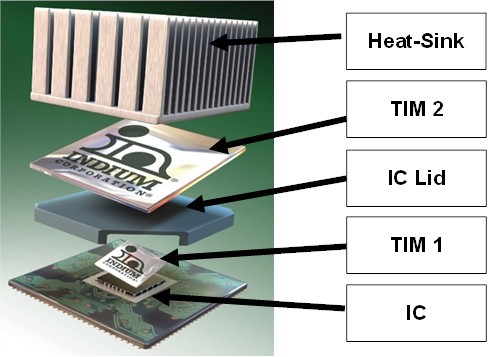
图 1.TIM1 将集成电路的热量传导至集成电路封装盖。TIM2 将集成电路封装盖的热量传导至散热器。
Jon: In the past, polymeric (traditional) TIMs, gels, and other non-metal TIMs were used. In some applications, they are still used today. The most common was thermal grease, which has been used for many decades. Thermal grease has a carrier that is almost like Vaseline®. The carrier is loaded with conductive particles. The thermal grease is then applied where the metal TIMs are in Figure 1. Thermal grease has two shortcomings. One is that its thermal conductivity is not sufficient to meet higher-heat fluxes generated by high performance computing (HPC), AI, accelerated process unit (APU), and graphics processing unit (GPU) trends. The other is that the on/off cycles of electronics can cause “pump-out.” Pump-out occurs when the thermal grease is pumped-out from the space that it occupies to conduct heat away from the IC. With the thermal grease pumped out, it can no longer perform its function.
Jon: This is where metallic based TIMs come in. They can provide the lowest thermal resistance and be customized for package-specific needs. They also do not typically experience pump-out.
Jon:随着 HPC 的发展,我们发现客户面临着更多的挑战,如芯片减薄和翘曲、热交叉(来自邻近元件的热量)以及其他各种设计挑战。对金属基 TIM 的需求持续增长,因为它们可以解决这些难题,并提供高功率密度应用所需的性能和可靠性。
Jon: 虽然 TIM 的主要目的是帮助将热量从热表面传递到冷表面,但在某些应用中还需要考虑其他属性(如装配简便性、可靠性、可持续性)。金属基 TIM 可分为焊接型(回流焊)、可压缩型(非回流焊)、液基型(液态金属 TIM)或相变 TIM。相变 TIM 的设计目的是在达到一定温度时改变相位。我们将在以后的文章中介绍所有这些金属 TIM。
乔恩:金属 TIM 的优点是具有 TIM 材料中最高的体积热导率,但必须认识到,体积热导率本身并不是选择 TIM 的唯一标准。热接触电阻或界面电阻通常主导 TIM 的整体热阻。因此,高表面润湿性以最小化热接触电阻是 TIM 性能的关键标准。
罗恩博士据我所知,TIM1 通常是焊接 TIM。你能解释一下它们是如何工作的吗?
Jon: TIM1 is commonly referred to as the interface between the backside of a die and the underside of an integrated heat spreader (IHS) and component cap. A soldered TIM (sTIM) at this interface is the “Cadillac” of TIMs. Once reflowed, sTIMs form intermetallic bonds that provide low interfacial resistance. Coupled with the fact that metal-based TIMs have high bulk thermal conductivity, the sTIM provides very low overall thermal resistance. sTIMs also mechanically fasten the die and IHS together given there is an intermetallic compound (IMC) formed at the interface. Often, we are asked if the rigidity of the solder joint could cause problems during power cycling. With the proper alloy and process, the sTIM can provide the ductility necessary during the life of the package, so rigidity issues are not a concern.
乔恩 There are many process considerations when selecting a sTIM. Indium Corporation has the experience and guidelines to help customers realize the benefits of sTIMs. One of the challenges in assembling TIM1s is voiding during reflow (see Figure 2). Voiding becomes worse after multiple reflows.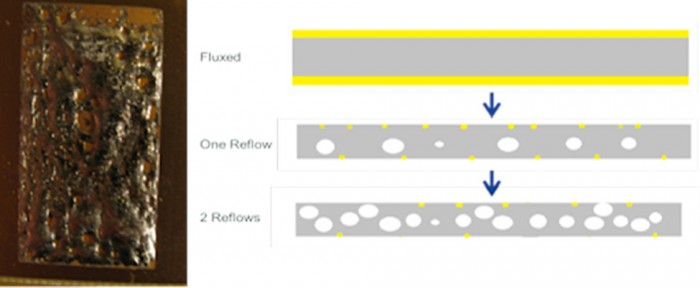
图 2.TIM1 位于芯片(或裸片)和 IHS 之间。
罗恩医生: 我知道在减少排尿方面有一些突破,你能解释一下吗?
Jon: 历史上,sTIM 主要用于 LGA 或 PGA 型封装。这些封装需要回流焊一次,以回流焊 sTIM。由于 sTIM 所带来的优势,人们正在努力寻找一种最佳的 sTIM 材料和工艺,用于能经受多次 BGA 回流焊循环(通常峰值温度为 240-250°C)的封装。传统的 sTIM 材料在每次回流时都会出现空隙增长,导致热性能变差。
(与纯铟相比,铟镁合金在减少后续回流的空隙增长方面有显著改善。见图 3)。
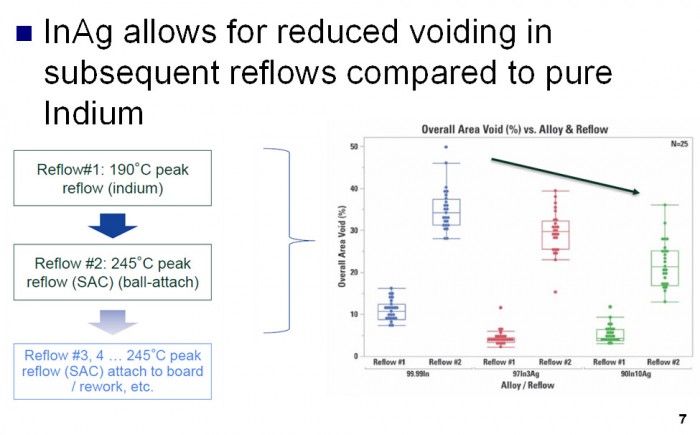
图 3与 In TIM1 相比,InAg TIM1 能明显减少排尿。
Jon: However, there are trade-offs to adding Ag to the solder joint. More Ag also means lower bulk thermal conductivity and a more rigid solder joint leading to reduced mechanical reliability. There is significant research underway to understand how different compositions of InAg wet to various surfaces and how they perform during reliability testing. High surface wetting, to minimize thermal contact resistance, is a critical TIM performance criterion. In addition, poor wetting can result in higher voiding, also leading to poor thermal performance. With the proper alloys selection, flux and process considerations sTIM can be adopted in Flip Chips BGA(FCBGA)style packages that will undergo multiple reflow cycles (see Figure 4).
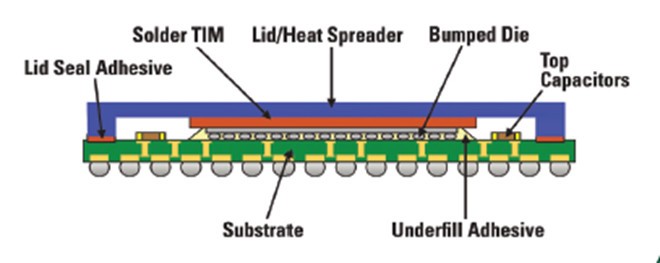
图 4.InAg sTIM 非常适合 FCBGA。
乡亲们
敬请关注我们关于 mTIMS1.5 的下一篇文章!
干杯
罗恩博士