Library
Blog
Topic
Type
Year
Author
Product Type

Become A Part of Patty and The Professor!
I have enjoyed writing the Patty and the Professor blog for about 10 years now. I’ve written about numerous real-life electronics assembly examples that I have encountered in my career, all
Avoid The Void™ – Identifying Causes of Die-Attach Soldering Voids
“How do I reduce my die-attach soldering voids?” is a question I am often asked by customers in the power semiconductor
Solder Spatter Matters
Within the cored solder wire industry, an increasing amount of attention is being given to the amount of spatter created during robotic and hand soldering applications. New products are being
Productivity is King in All Types of Manufacturing Processes
Folks, It's been way too long, let's look in on Patty and the boys….. It was 5:30AM and Patty’s alarm went off. She was unusually tired today because of a PTA meeting last
Gallium: Unsung Hero in Modern Living?
Folks, Outside of the walls of Indium Corporation few people likely hear the word “gallium” spoken very often. Yet, in one important way, gallium is fundamental to modern living:
What are solder preforms?
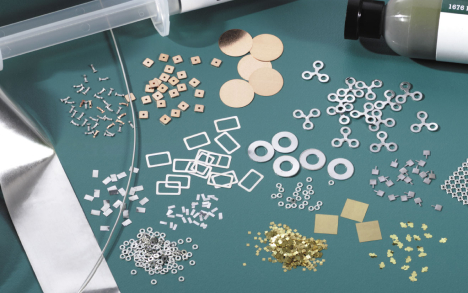
As a technical support engineer,I get this question quite often. A solder preform is a solid, flat, manufactured-shape of solder that can be used for a wide variety of assembly applications. Solder
Stages of a Reflow Profile: Part IV
Happy New Year everyone! Typically the new year signals a new beginning, but thispost will be concluding our series on reflow profilingby discussing the fourth stage of a reflow profile: the
A Precise Equation Relating Karats of Gold to Density in Gold Alloys
Folks, Some years ago I received the request below: Hi Dr. Lasky, I am a precious metals recycler and would very much appreciate your verifying the validity of an equation that approximates the Karat
Patty and the Professor Flashback: Uptime Part 4
Folks, the adventures of The Professor continue……… So far the meeting with The Professor had proven very valuable John thought.He was anxious to hear the other suggestions that The
The Professor’s second visit to ACME….. continued
"Well what should we do Professor?" John said weakly. "Clearly, not shut the line down over the lunch break," The Professor responded quickly. "We can't!"said John,
The Return of Patty and the Professor: Uptime Part 2
Folks, For the next few weeksI plan to repost some of the first Patty and the Professor episodes. As I visited several facilities, some of them in other industries, I found that uptime is as vital a
The Return of Patty and the Professor
Folks, I teach a course at Dartmouth on manufacturing processes: ENGM 185. In this course, I use many of the chapters from “The Adventures of Patty and the Professor.” This book started as a
Assured Solder Recycling Program
While Indium Corporation is well-knownas a solder supplier, it is less known for its ability to recycle solder.Indium Corporation’s solder reclaim program uses state-of-the-art electrolytic
Hypothesis Test Spreadsheet for Cpk of Stencil Printing Transfer Efficiency
Folks, It is accepted as fact by everyone that I know that 2/3rd of all SMT defects can be traced back to the stencil printing process. A number of us have tried to find a reference for this posit,
Stages of a Reflow Profile: Part III
In my previous post on this topic, Stages of a Reflow Profile: Part II, I mentioned a few profile-induced soldering defects, including graping, tombstoning, and voiding. In this post,we will talk
Gallium-Indium Liquid Metal Self-Healing Electronics, Part 5 of 5
This week we learned about an exciting new liquid metal-infused polymer, made with a gallium-indium alloy, which can be used to form circuits that heal themselves after being damaged. Today, Eric
Gallium-Indium Liquid Metal Self-Healing Electronics, Part 4 of 5
Over the last few days we have learned about how to create stretchable electronics from gallium and indium embedded into an elastomer. Today we continue the conversation with Eric Markvicka and look
Gallium-Indium Liquid Metal Self-Healing Electronics, Part 3 of 5
We are back again with Eric Markvicka to talk about how easy it is to form a stretchable electrical circuit with liquid metal-embedded material and some simple tools. Jim: Eric, at first blush your
Gallium-Indium Liquid Metal Self-Healing Electronics, Part 2 of 5
Yesterday Eric Markvicka demonstrated self-healing electronics for us with his video of a liquid metal embedded elastomer. Today, we discuss a composite material that is electrically insulating until
An Overview of Vacuum Reflow Soldering
Brook Sandy-Smith, Technical Support Engineer for PCB Assembly Materials, and Phil Zarrow, discuss how vacuum reflow soldering can be used to reduce voiding. Phil Zarrow: Brook, there's been a
Gallium-Indium Liquid Metal Self-Healing Electronics, Part 1 of 5
This week we will be discussing the future of self-healing electronics with Eric Markvicka of Carnegie Mellon University. At the time of writing this, Eric is a PhD Student working on his thesis:
Not sure what you need?
Let us help.
At Indium we research, develop, and manufacture advanced electronics assembly materials solutions to the challenges of today, tomorrow, and the future.