Library
Blog
Topic
Type
Year
Author
Product Type

Indalloy®292 – Reliability on Every Surface
So,soldering:In any case I can think of, it creates acontinuous metal connection. In our corner of the industry (PCBA), that connection isbetween the metal pad of a circuit board board and a
One Last Blog Post…
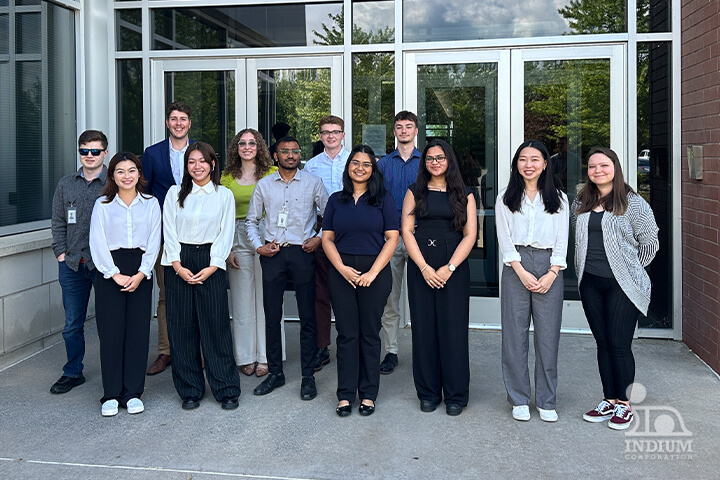
Long time, no talk! With this being the last week of the 2020 Internship Program, there has been a great deal of reflection done on these past 10 weeks. I can only speak for myself when I make a
Thank You Indium Corporation!
As we come to our final week as interns, many of us have spent time reflecting on our experience. The skills, knowledge, and advice we have gained from this internship have made us better
You Live, You Lunch, and You Learn
As my summer internship winds down, I reflect on my exceptionally unique experience here at Indium Corporation by sifting through memories, picking out highlights of lifelong lessons learned during
Being a Biological Engineer in a Manufacturing Facility
“Required: Pursuing a Degree in Mechanical Engineering…Pursuing a Degree in Industrial Engineering”. It would be an understatement that these phrases worried me as I applied for an
What the Off-Eutectic?
When we talk about off-eutectic alloys, we must take a step back and talk about what makes a eutectic alloy. Each solder alloy has both a solidus (not melted) and liquidus (completely melted)
Calculating Small P Values in Hypothesis Testing
Folks, Let's continue watching Patty help Mark to determine small P values in hypothesis testing. The first part of this story is here. Patty and Mark chatted for awhile and reviewed some of the
Solder Alloys & A Sense of Belonging
And with the seventh week coming to a close, I find myself generating more questions about my work than at the end of week
Women in Engineering: Part One
What does it take to pursue a technical field? This was a question I wondered when I first stepped foot on my college campus. As I observed the students at my school, I noticed the ratio of males to
Women in Engineering: Part Two
Welcome Back! In this video, we will discover the opportunities available to women in engineering. This includes everything from professional networking to activities offered on campus. The interns
Dare to Dream
What do you want to be when you grow up? I think I’ve had a hundred different responses to this question. I remember when I was first asked this question, I was a tiny first grader who wanted
In Hypothesis Testing, the P Value Can’t Be Zero.
Folks, we haven't checked on Patty in a while… As Patty walked into her office, her phone rang. “Hello, this is Professor Coleman, how may I help?” Patty cheerfully answered.
Do you have any questions for me – YES!
I’m 99.99% sure that if you asked anyone, and I mean ANYONE, what to have prepared for any interview, they would answer, “a question”. Not always the easiest, but always a
The Anti-Toby HR Club
Hello and welcome back. For those of you who are new to the Indium Corporation blogs, I’m Maria Vacca, the Human Resources Intern. Now that our brief introduction is done, let’s jump into
Letting Go of My List
Don’t get me wrong; I love lists! Seriously, from keeping track of groceries to reminding me of my favorite songs, they help me in so many ways. No doubt about it: a little organization goes a
Why Indium Corporation?
Welcome to my first ever blog post! I can only assume the first person to read this will be Joy, the awesome intern who helps me come up with blog post ideas. However, if you’re not Joy, then
Tin Pest in Medieval Culture
Folks, Readers may remember that I have had an interest in tin pest for some time. Tin pest can occur if nearly-pure tin is exposed to cold temperatures (<13.2oC) for long periods of time. At the
Where My First Steps Took Me
To any other person, June 15th would just be a Monday. For me, it was the start of a new beginning. I remember the first thing I saw was my calendar reminder. Even the plain reminder brought me a mix
New Beginnings & Mutual Investments
In the tumultuous age of COVID-19, I am still fortunate enough to have an in-person experience this summer working as a Materials Engineering Intern here at Indium
The Power of Perspective
When I first thought of Indium Corporation, I thought of a production facility; a place filled with complex machinery and operators wearing white lab coats. While it is true that Indium Corporation
Stencil Aperture Design for the Pin in Paste (PIP) Process
Peter writes, Dear Dr. Ron, I am trying to implement the Pin-in-Paste (PIP) process. The PWB is 63 mils thick, the component pin diameter is 47 mils, the PWB hole diameter is 87 mils, and the PWB pad
Not sure what you need?
Let us help.
At Indium we research, develop, and manufacture advanced electronics assembly materials solutions to the challenges of today, tomorrow, and the future.