Professionals in the Printed Circuit Board (PCB) industry are all too familiar with common solder defects like tombstoning and head-in-pillow. These defects pose significant risks to the performance of both the affected components and the boards themselves.
In my conversations with customers, I’ve noticed the terminology for these defect types often gets misconstrued. People frequently lump both into one overarching category. I have even experienced customers referring to head-in-pillow defects as tombstoning. This creates confusion because these defects have differing causes and distinct troubleshooting recommendations.
Both defects involve a lack of contact and soldering between two surfaces of the assembly, leading to this misinterpretation. This post will clearly outline the characteristics of each to provide you with an informative foundation to effectively and accurately diagnose your defects.
What is Tombstoning?
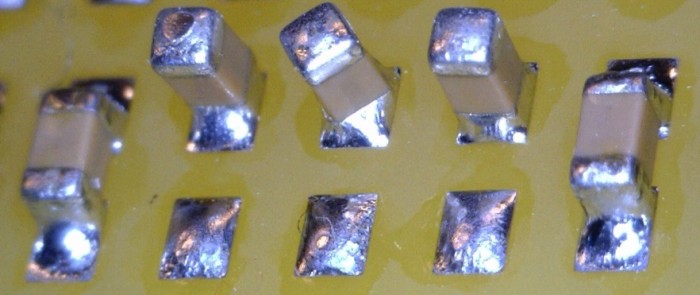
Tombstoning is arguably one of the most visibly apparent defects in PCB manufacturing. When viewing this defect, you will see a component standing vertically on its end, resembling a tombstone in a cemetery.
Occurring primarily on small passive components, the main cause is the uneven wetting of the solder pads. If one pad wets before the other, the surface tension of the wet pad pulls the component. This force causes it to rise, preventing the formation of a complete solder joint on the opposite pad.
(Note: Figures 4.1 and 4.2 of The Printed Circuit Assembler’s Guide to Solder Defects illustrate this well.)
Troubleshooting Tombstoning
We use a variety of troubleshooting methods to address tombstoning. Pad design is one of the first aspects we consider during an investigation. If the pads for the affected components are different sizes or shapes, they may contribute to the uneven surface tension applied to the component. We often recommend ensuring pads are of similar size and shape to minimize these opposing forces.
Altering the reflow process can also help mitigate the frequency of tombstoning. Introducing a shoulder profile or a short soak can help ensure that both pads associated with the affected component wet at the same time.
What is Head-in-Pillow?
Unlike tombstoning, head-in-pillow defects are notoriously difficult to detect visually. They often require X-ray inspection or cross-sectioning to pinpoint the exact location.
Occurring primarily on BGAs, this defect appears when the solder ball on the BGA is unable to coalesce with the solder paste deposit on the PCB. BGA warpage is the main culprit here. During reflow, the BGA heats up and warps, which can cause separation between the BGA solder balls and the solder paste deposits.
Once the reflow process is complete and the BGA cools down, the degree of warpage lessens. The solder balls and solder paste deposits eventually come back into contact. However, even though the solder melted during reflow, there is often too much oxidation in soldering surfaces when they reunite. This prevents the solder from coalescing and creating a sufficient solder joint. The result is a gap between the solder ball and the solder paste deposit, reminiscent of a person laying their head down on a pillow.
(Note: Figure 3.1 of The Printed Circuit Assembler’s Guide to Solder Defects is a good reference here.)
Troubleshooting Head-in-Pillow
Troubleshooting recommendations to mitigate head-in-pillow defects revolve around decreasing the distance between the BGA solder balls and the solder paste deposits on the PCB.
- Print Efficiency: Achieving effective transfer efficiency while printing helps ensure there is not a large gap between the solder balls and solder paste prior to reflow.
- Reflow Optimization: Another approach is optimizing the reflow profile to minimize BGA warpage. You can accomplish this by decreasing the heat and the time-above-liquidus (TAL) to prevent the component from getting overly hot during the reflow step.
- Material Selection: Additionally, specific solder pastes, such as Indium Corporation®’s Indium10.8HF, have been developed with characteristics to reduce the frequency of head-in-pillow defects.
While it is difficult to detect, you can regulate head-in-pillow defects with specific process and material alterations.
Conclusión
Head-in-Pillow and tombstoning defects are often referred to interchangeably, but they are two very different occurrences in PCBs that require distinct troubleshooting steps. While tombstoning is usually seen in small components experiencing uneven wetting forces, head-in-pillow occurs primarily in BGAs that undergo warpage during the reflow process.
Understanding the differences between these two defect categories helps streamline communication between the customer and manufacturer. Ensuring both parties are on the same page allows you to successfully mitigate these issues as soon as possible. If you are interested in learning more, check out Indium Corporation’s The Green Light Guide to Eliminating Printed Circuit Assembly Soldering and Manufacturing Defects digitally or buy a copy on Amazon.