
Megyn Woodly had just finished a three-day audit of Andover Electronics Assembly’s four assembly lines. She felt the factory was well organized, run with high first-pass yields, and quite good productivity. She was just finishing reviewing Andover’s strengths and giving this summary to senior management and engineers:
“I have audited 30 factories worldwide, and Andover is in the top five in terms of quality and productivity. It is especially impressive how you handle changeovers, an important skill for a high-mix company like Andover,” she summed up.

Figure 1. Megyn Woodley explaining the statistical analysis she used to support her audit of Andover Electronics Assembly.
Megyn continued, “Regarding opportunities for improvement, I found one major one. Andover is losing 24 minutes of production on each shift per day per line. Since Andover is a low-margin business, this lost productivity is costly.”
Charles Barkley, head of production, turned red in the face and fumed at Megyn. “I find this unfounded finding insulting,” he shouted at Megyn.
As Charles prepared to rant at Megyn, company president Melissa Baron calmly said, “Charlie, calm down. Megyn, can you elaborate?”
“Although your solder paste prints well and provides good first pass yields, it has poor response-to-pause,” Megyn started.
“What is response-to-pause? Why is it a problem?” Melissa asked.
“When the operators have to pause production to add components to the placement machines or perform any other type of assist, the solder paste stiffens up. As a result, your operators have to perform a few kneading prints before they start production. This takes about 6 minutes, and it happens about 4 times each shift,” Megyn summarized.
Charles was getting redder in the face with each word Megyn said.
“How much does this cost us? Melissa asked.
“About $1 million per year.”
At this Charles Barkley exploded, “This is all gobbledygook! I don’t believe any of it.”
“What is the fix?” Melissa asked.
Megyn responded, “A different solder paste.”
Charlie snapped, “I know the solder paste you are referring to; it’s too damned expensive!”
At that, Chalie left the room in a huff.
Melissa asked, “Is it more expensive?”
“Not really,” Megyn answered, “and you are actually losing additional money through the dummy prints that your operators have to perform to loosen up the paste, since that paste is thrown away. But this amount of money is incidental. The real cost is the lost revenue from the poor response-to-pause.”
“Where do you get the 1 million dollar loss from?” asked COO Frank Blaine.
“Well, you are losing 24 minutes per line, per shift. Multiplied over all your lines, this adds up to enough production to be worth a little over $1 million per year,” Megyn explained.
“But just 24 minutes in an 8 hr shift?” Frank pleaded.
“Your lines have a best of breed 40% uptime, which results in 192 minutes of production, so 24 minutes is greater than 12% of the production.” Megyn elaborated.
Frank seemed stunned by the numbers.
“I’ve worked it all out in a spreadsheet,” Megyn said.
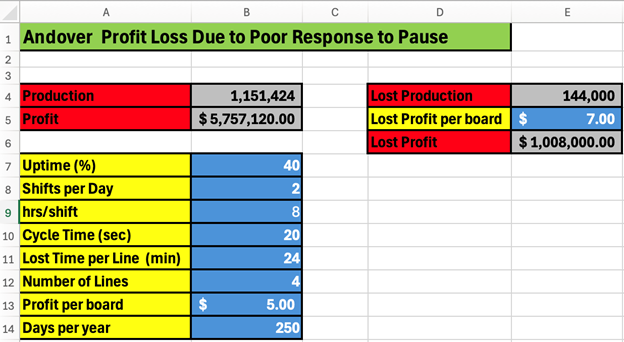
Figure 2. The Andover lost profit.
“Note that I estimated your yearly production at a little over 1.1 million PCBAs and profit about $5.8 million, as seen in cells B4 and B5,” Megyn said.
“Wow! Your numbers are quite close,” Melissa said.
“I agree,” Frank added. “How did you get so close?”
Megyn chuckled, “Well, this is my expertise, and I did get information from your team.”
“Tell us about the lost profit?” Melissa asked.
“Those calculations are in cells E4, E5, and E6,” Melissa explained.
The Andover team studied the spreadsheet for a few moments.
“Why do you show the profit for regular production boards at $5 per board, in cell B13, and yet the lost profit boards at $7 per board in cell E5?” Frank asked.
“If you start using a solder paste that has good response-to-pause, every extra board you produce will have been produced with no extra non-material costs like labor, rent, electricity, etc. So, the profit per board will be greater,” Megyn responded.
“That’s a simple explanation…” Frank mused.
“And over $1 million in lost profit is a shocker,” Melissa chimed in.
“Megyn, could you show us how to evaluate response-to-pause of our current solder paste and some other solder paste candidates?” Frank asked.
Stay tuned to see how to evaluate solder paste for response to pause.
Santé,
Dr. Ron