
皆さん、
A short time ago, I posted “Metal TIMs 101: Chapter 1” with Jon Major. Now it is time for Chapter 2!
ロン博士:ジョン、TIM1.5とは何ですか?
Jon: TIM1.5 commonly refers to the interface between a bare die (a die without a lid) and a heat-sink or cold plate. Unlike TIM1, there is no heat spreader, and therefore the die is in direct contact with the cooling solution. See Figure 1. We refer to TIM1.5 as a system level TIM because the CPU/GPU/ASIC is already soldered onto a PCB, so the TIM is applied during system assembly (sometimes referred to as FATP (Final Assembly, Test and Pack)). Most TIM1.5 packages are considered lidless BGA style packages. TIM2 is also a system level TIM in many products.
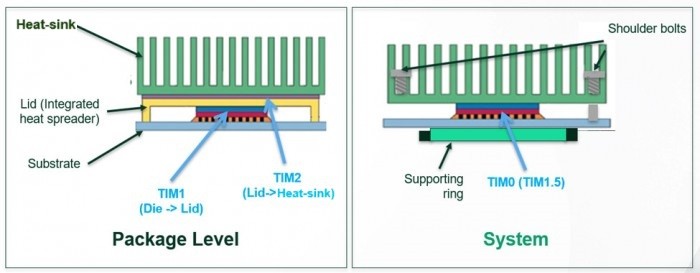
図1.TIM1、TIM2、TIM1.5のアプリケーション
ロン博士TIM1.5はいつ使うのですか?
Jon: Each interface in a thermal stack up adds thermal resistance. By eliminating the lid in a design, the total thermal resistance between the die and cooling solution is reduced in theory. However, the thermal interface material used in a TIM1.5 application plays a very important role in the performance of the overall thermal stack-up. Often, packages used in High Performance Computing (HPC) applications like GPUs, CPUs, or sometimes ASICs are designed without a lid to minimize thermal resistance, so a TIM1.5 material is then needed. Figure 2 shows a TIM1.5 covering four integrated circuit (IC)dies ready for the attachment of the heat-sink.
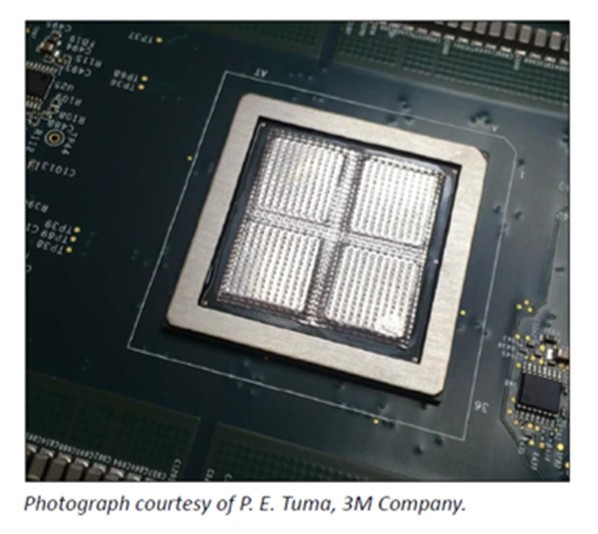
図2.TIM1.5で4つのICダイを覆い、ヒートシンクの装着を待つ。
ロン博士TIM1.5の課題は何ですか?
Jon: The primary purpose of a TIM is to fill air gaps between a hot surface, such as the semiconductor die, and a cold surface, such as a heat-sink. Although metal-based TIMs have very high bulk thermal conductivity compared to polymeric based TIMs, thermal conductivity is not the sole criteria for selecting a TIM; the resistances at the interfaces of the TIM with the IC and the heat-sink are also important. So, for metal TIMs, it is important to have a metal solution with low thermal interface resistance. In addition, it is important to understand that a TIM that works well for one package style may not be ideal for others. Understanding how the TIM will be applied during system assembly is also critical. We see compressible metal TIMs, soldered TIMs, as well as liquid metal TIMs used in TIM1.5 applications. The challenges we help customers solve in TIM1.5 applications are primary focused around thermal resistance, surface wetting, surface flatness, surface roughness, clamping force, reflow temperature (if soldered), surface metallizations, void inspection methods, long-term reliability, as well as process implementation and optimization. Some customers prefer to use a solder TIM for TIM1.5, others compressible TIMs and many are interested in liquid metal TIMs because of its thin bondline thickness (BLT), excellent wetting, and low interfacial resistance.
ロン博士TIM1.5で使われている圧縮性金属TIMについて教えてください。
Jon: Flat metallic foils have been used as a compressible TIM for several decades. Typically, they are indium metal or copper shims used in the telecom, military, or RF spaces, among others. In 2008, Indium Corporation patented a patterned metallic foil called “Heat-Spring®“, which is now a family of various alloys and pattern types designed to address a variety of high-performance applications, including TIM1.5, TIM2, burn-in, large area baseplates to cold plates for high power applications like IGBTs (insulated gate bipolar transistor) and SiC packages, as well as immersion cooling applications. The patterned metal helps to improve the thermal interface conductivity by eliminating air pockets between the TIM and heat-sink and the TIM and IC. Good thermal interface conductivity is a critical performance criterion for a compressible metal TIM.
Heat-Spring®は軟質金属合金サーマルインターフェイス材(SMA-TIM)です。非リフローの圧縮性TIMで、パターン化されているため塗布が非常に簡単です。平坦な金属箔と比較して、ダイやヒートシンク表面へのコンプライアンスが向上します。圧力はパターン内の小さな接触部分に集中し、塑性変形を起こして接触が改善されるため、時間の経過とともに熱抵抗が減少します。Heat-Spring®は、2つの表面間で圧縮されると、それらの表面が反っていたり、粗かったり、同一平面でなくても、超低熱抵抗を提供します。TIM1.5として使用する場合、Heat-Spring®は複雑でコストのかかるシステムレベルのリフロー工程を必要とせず、金属ベースのTIMソリューションを提供します。
We recently developed an innovative new pattern called “HSx” that uses a new fabrication technique, offering increased compliancy for bowed or higher warpage dies (>150 μmof warpage) that also provides ultra-low thermal resistance with less pressure (30 psi) compared to our current patterns (HSD and HSHP (high profile)). See Figure 3.
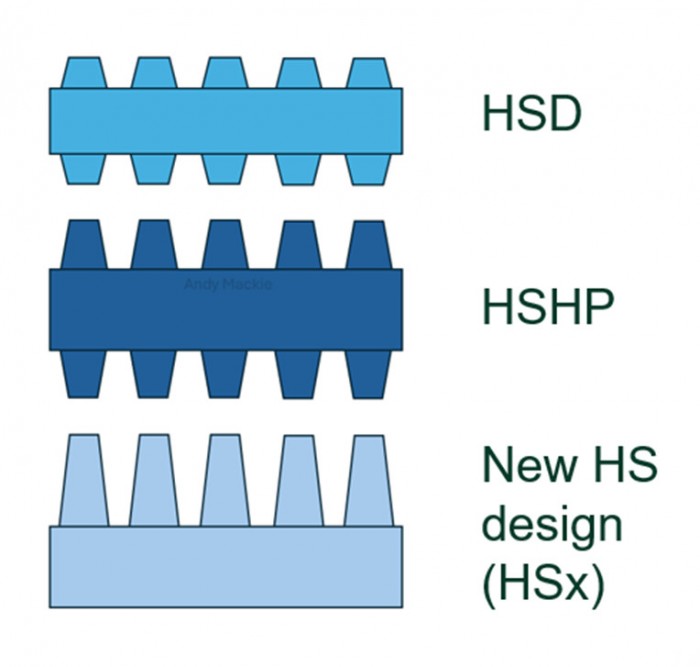
図3.さまざまなヒートスプリング®パターン。
Heat-Spring® compliancy improves with time and thermal cycling, referred to as “burn-in”. HSx has an especially short burn-in period and performance improves with thermal cycling. See Figure 4.
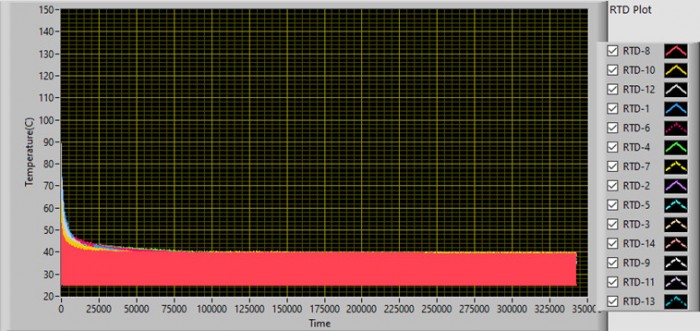
Figure 4. Power cycling of HSx, 0-600 Watts for 35,000 cycles. Tj reduces over time and stabilizes as seen above.
Customers continue to see warpage as a major challenge, given the CTE mismatch between the substrate and silicon chip. Thus, we developed the new pattern with warpage in mind. Because there is no backside metallization needed, HSx is an ideal TIM1.5 option for application where at least 30 psi of clamping force is available.
ロン博士 なぜサーマルグリースを使わないのですか?熱伝導グリスは反りによく効くし、昔から使われている。
Jon: For some applications, thermal grease is a perfectly acceptable TIM, so long as the power is low. For such low-power density applications, grease often will perform just fine, but there is always a risk of “pump-out,” which happens when thermal cycling and CTE mismatches actually pump the thermal grease out of the TIM interface, often leading to thermal failure. Solid metal TIMs, however, are not subject to the pump-out failure mode and are ideally suited for high-power density components.
ロン博士図5から、銅の方がバルク熱抵抗が低いことがわかります。なぜ銅を使わないのですか?

図5.代表的な材料の熱抵抗とボンドライン厚さ(BLT)の関係
Jon: Although copper has an impressive bulk thermal conductivity of almost 400 W/mK, it is too hard and non-compliant to connect directly to a die as a TIM. It is not possible to apply enough pressure to plastically deform copper to fill in air gaps without crushing the die. The challenge of copper TIMs can be seen in Figure 6. Note the high-gap thermal resistance of copper as a function of pressure compared to indium. Figure 5 also shows the very high thermal resistance of thermal grease.
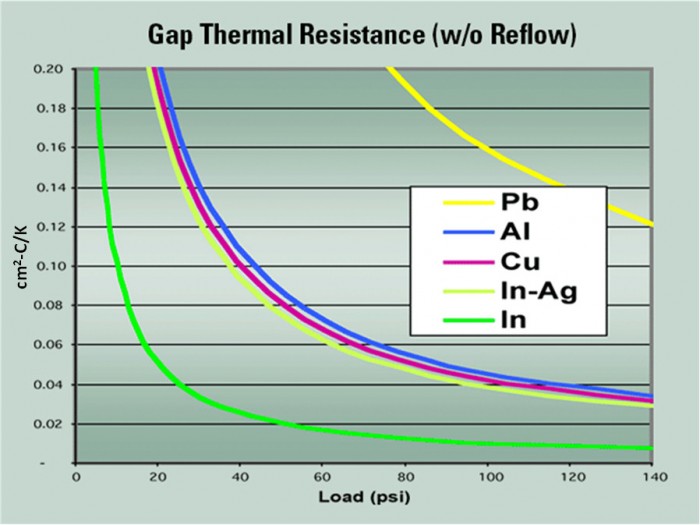
図6.代表的な金属の熱間ギャップ抵抗を圧力の関数として示す。
Dr.ロン:ヒートスプリング®は液浸冷却でどのように機能するのですか?
Jon: Heat-Spring® is a proven TIM in both direct-to chip (DTC) and immersion cooling applications. It’s rather common to see Heat-Spring® used as a TIM in immersion systems. Unlike thermal greases or popular polymer phase change materials (PCMs), Heat-Spring®s will neither dissolve nor contaminate standard organic or fluorinated dielectric immersion fluids. It’s easy to install either as a TIM2 or TIM1.5 – simple place the Heat-Spring® and clamp the heat-sink or cold plate to the assembly. We also have new novel ways of applying the Heat-Spring®, which further reduces contact resistance. We are looking forward to introducing these new methods to industry in the near future.
ロン博士 ヒートスプリングはリサイクル可能ですか?
ジョン:はい!インジウムベースのヒートスプリング®は100%再生可能で、持続可能性プログラムにとって大きなメリットがあります。材料を埋立地に送るのではなく、使用済みのインジウムや他の多くの金属を買い取り、再び使用することができるのです。
ロン博士: ジョン、ありがとう。近い将来、熱管理の課題に対する他のTIMソリューションについて議論しましょう。
ジョン:そうだろうね!