
여러분,
A short time ago, I posted “Metal TIMs 101: Chapter 1” with Jon Major. Now it is time for Chapter 2!
론 박사님 존, TIM1.5가 무엇인가요?
Jon: TIM1.5 commonly refers to the interface between a bare die (a die without a lid) and a heat-sink or cold plate. Unlike TIM1, there is no heat spreader, and therefore the die is in direct contact with the cooling solution. See Figure 1. We refer to TIM1.5 as a system level TIM because the CPU/GPU/ASIC is already soldered onto a PCB, so the TIM is applied during system assembly (sometimes referred to as FATP (Final Assembly, Test and Pack)). Most TIM1.5 packages are considered lidless BGA style packages. TIM2 is also a system level TIM in many products.
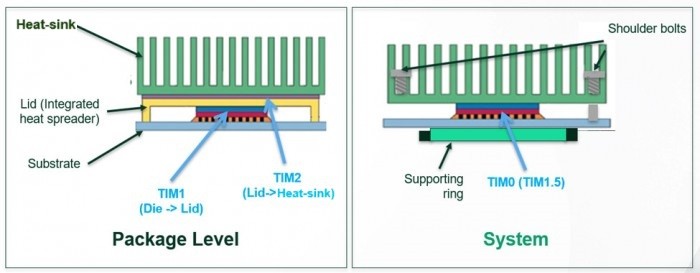
그림 1. TIM1, TIM2 및 TIM1.5의 애플리케이션
론 박사님 TIM1.5는 언제 사용되나요?
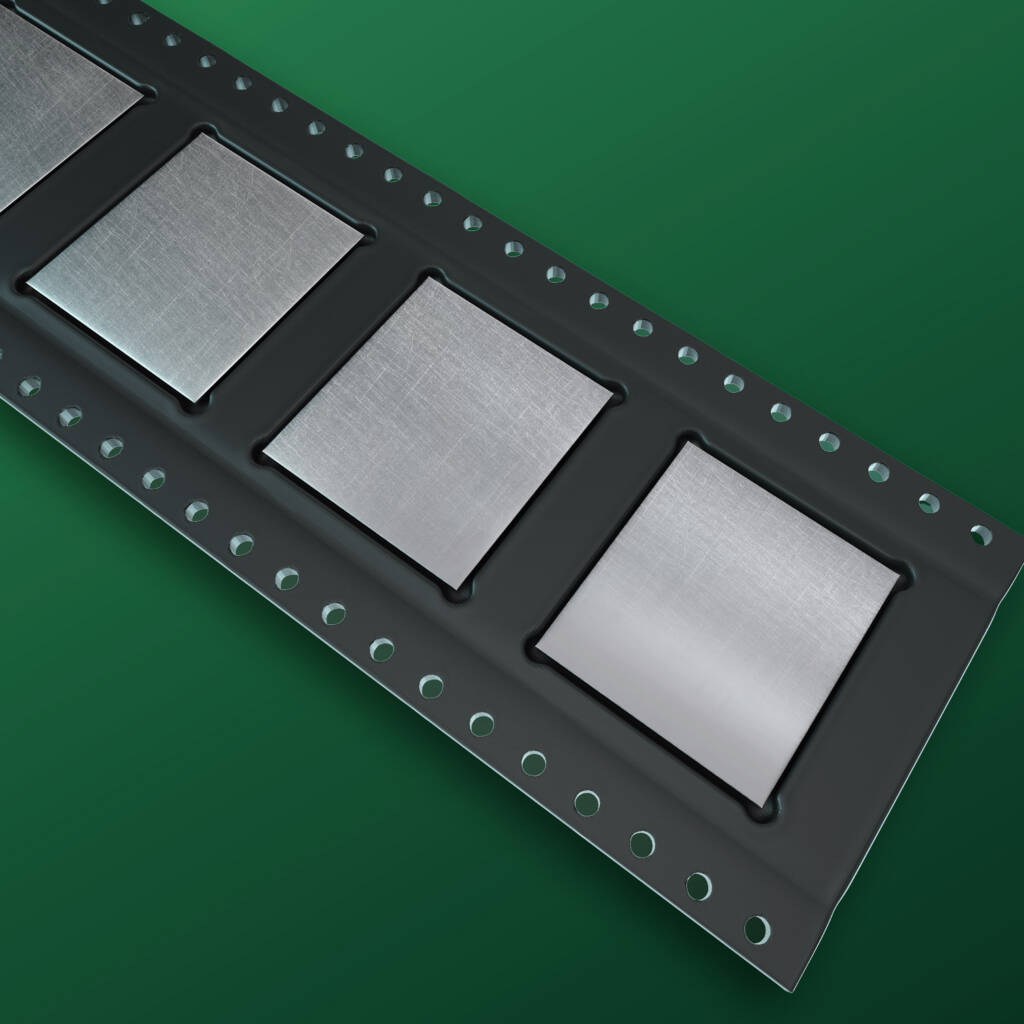
Jon: Each interface in a thermal stack up adds thermal resistance. By eliminating the lid in a design, the total thermal resistance between the die and cooling solution is reduced in theory. However, the thermal interface material used in a TIM1.5 application plays a very important role in the performance of the overall thermal stack-up. Often, packages used in High Performance Computing (HPC) applications like GPUs, CPUs, or sometimes ASICs are designed without a lid to minimize thermal resistance, so a TIM1.5 material is then needed. Figure 2 shows a TIM1.5 covering four integrated circuit (IC)dies ready for the attachment of the heat-sink.
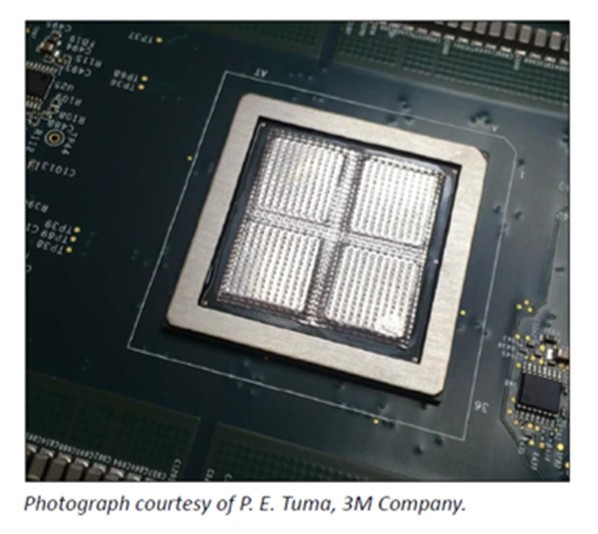
그림 2. 방열판 적용을 기다리는 4개의 IC 다이를 덮고 있는 TIM1.5.
론 박사님 TIM1.5의 문제점은 무엇인가요?
Jon: The primary purpose of a TIM is to fill air gaps between a hot surface, such as the semiconductor die, and a cold surface, such as a heat-sink. Although metal-based TIMs have very high bulk thermal conductivity compared to polymeric based TIMs, thermal conductivity is not the sole criteria for selecting a TIM; the resistances at the interfaces of the TIM with the IC and the heat-sink are also important. So, for metal TIMs, it is important to have a metal solution with low thermal interface resistance. In addition, it is important to understand that a TIM that works well for one package style may not be ideal for others. Understanding how the TIM will be applied during system assembly is also critical. We see compressible metal TIMs, soldered TIMs, as well as liquid metal TIMs used in TIM1.5 applications. The challenges we help customers solve in TIM1.5 applications are primary focused around thermal resistance, surface wetting, surface flatness, surface roughness, clamping force, reflow temperature (if soldered), surface metallizations, void inspection methods, long-term reliability, as well as process implementation and optimization. Some customers prefer to use a solder TIM for TIM1.5, others compressible TIMs and many are interested in liquid metal TIMs because of its thin bondline thickness (BLT), excellent wetting, and low interfacial resistance.
론 박사님: TIM1.5에 사용되는 압축성 금속 TIM에 대해 알려주세요.
Jon: Flat metallic foils have been used as a compressible TIM for several decades. Typically, they are indium metal or copper shims used in the telecom, military, or RF spaces, among others. In 2008, Indium Corporation patented a patterned metallic foil called “Heat-Spring®“, which is now a family of various alloys and pattern types designed to address a variety of high-performance applications, including TIM1.5, TIM2, burn-in, large area baseplates to cold plates for high power applications like IGBTs (insulated gate bipolar transistor) and SiC packages, as well as immersion cooling applications. The patterned metal helps to improve the thermal interface conductivity by eliminating air pockets between the TIM and heat-sink and the TIM and IC. Good thermal interface conductivity is a critical performance criterion for a compressible metal TIM.
Heat-Spring®은 연질 금속 합금 열 인터페이스 재료(SMA-TIM)입니다. 이 제품은 패턴화되어 있어 적용이 매우 쉬운 비리플로 압축 가능한 TIM입니다. 평평한 금속 포일에 비해 다이 및 방열판 표면에 대한 순응도가 높습니다. 패턴의 작은 접촉 영역에 압력이 집중되어 소성 변형이 발생하고 접촉이 개선되어 시간이 지남에 따라 열 저항이 감소합니다. 두 표면 사이에 압축된 Heat-Spring®은 표면이 휘어지거나 거칠거나 동일 평면이 아닌 경우에도 매우 낮은 열 저항을 제공합니다. TIM1.5로 사용할 경우 Heat-Spring®은 복잡하고 비용이 많이 드는 시스템 레벨 리플로우 공정 없이도 금속 기반 TIM 솔루션을 제공합니다.
We recently developed an innovative new pattern called “HSx” that uses a new fabrication technique, offering increased compliancy for bowed or higher warpage dies (>150 μmof warpage) that also provides ultra-low thermal resistance with less pressure (30 psi) compared to our current patterns (HSD and HSHP (high profile)). See Figure 3.
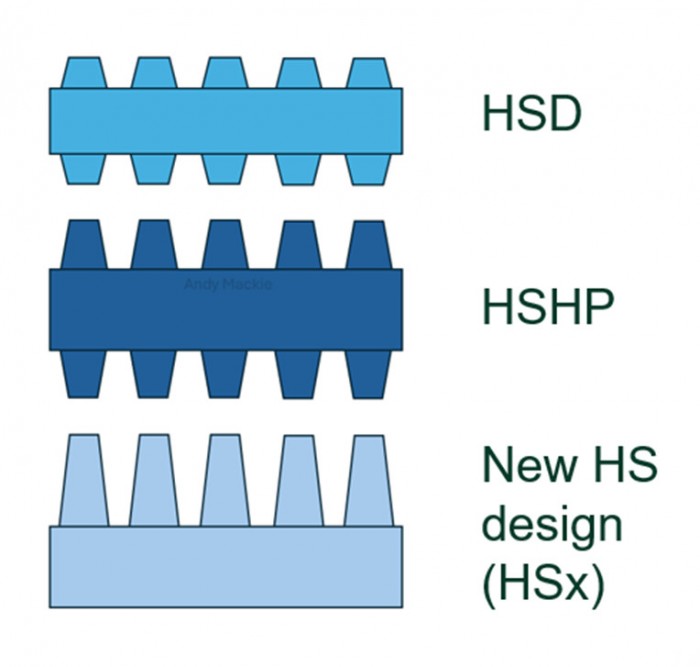
그림 3. 다양한 Heat-Spring® 패턴.
Heat-Spring® compliancy improves with time and thermal cycling, referred to as “burn-in”. HSx has an especially short burn-in period and performance improves with thermal cycling. See Figure 4.
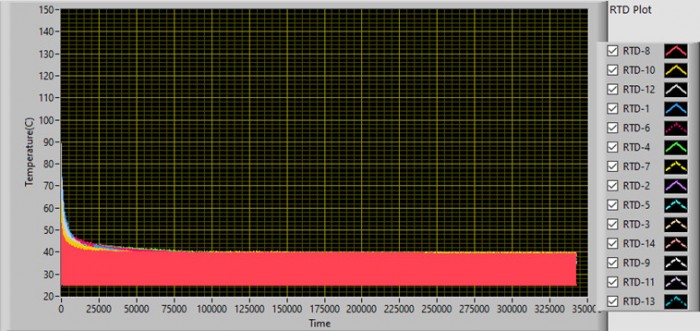
Figure 4. Power cycling of HSx, 0-600 Watts for 35,000 cycles. Tj reduces over time and stabilizes as seen above.
Customers continue to see warpage as a major challenge, given the CTE mismatch between the substrate and silicon chip. Thus, we developed the new pattern with warpage in mind. Because there is no backside metallization needed, HSx is an ideal TIM1.5 option for application where at least 30 psi of clamping force is available.
론 박사님 열 그리스를 사용하지 않는 이유는 무엇인가요? 뒤틀림에 잘 견디는 것 같고 오랫동안 사용되어 온 제품입니다.
Jon: For some applications, thermal grease is a perfectly acceptable TIM, so long as the power is low. For such low-power density applications, grease often will perform just fine, but there is always a risk of “pump-out,” which happens when thermal cycling and CTE mismatches actually pump the thermal grease out of the TIM interface, often leading to thermal failure. Solid metal TIMs, however, are not subject to the pump-out failure mode and are ideally suited for high-power density components.
론 박사: 그림 5에서 구리는 벌크 열 저항이 낮습니다. 구리를 사용하지 않는 이유는 무엇인가요?

그림 5. 대표적인 소재의 열 저항과 본드라인 두께(BLT) 비교
Jon: Although copper has an impressive bulk thermal conductivity of almost 400 W/mK, it is too hard and non-compliant to connect directly to a die as a TIM. It is not possible to apply enough pressure to plastically deform copper to fill in air gaps without crushing the die. The challenge of copper TIMs can be seen in Figure 6. Note the high-gap thermal resistance of copper as a function of pressure compared to indium. Figure 5 also shows the very high thermal resistance of thermal grease.
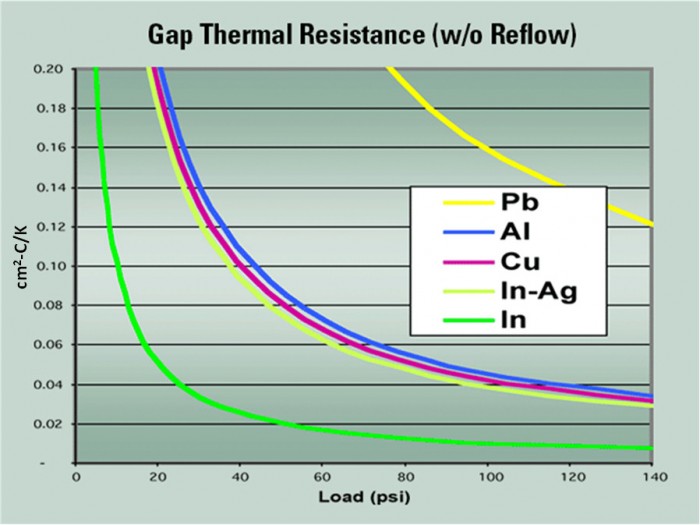
그림 6. 압력에 따른 대표적인 금속의 열 갭 저항.
론 박사: 침수 냉각에서 Heat-Spring®은 어떻게 작동하나요?
Jon: Heat-Spring® is a proven TIM in both direct-to chip (DTC) and immersion cooling applications. It’s rather common to see Heat-Spring® used as a TIM in immersion systems. Unlike thermal greases or popular polymer phase change materials (PCMs), Heat-Spring®s will neither dissolve nor contaminate standard organic or fluorinated dielectric immersion fluids. It’s easy to install either as a TIM2 or TIM1.5 – simple place the Heat-Spring® and clamp the heat-sink or cold plate to the assembly. We also have new novel ways of applying the Heat-Spring®, which further reduces contact resistance. We are looking forward to introducing these new methods to industry in the near future.
론 박사님 온천수는 재활용할 수 있나요?
존: 네! 인듐 기반 히트 스프링®은100% 재활용이 가능하며 지속 가능성 프로그램에 엄청난 이점이 있습니다. 폐기물을 매립지로 보내는 대신 사용한 인듐과 기타 여러 금속을 매입하여 다시 사용할 수 있습니다.
론 박사님 존, 고마워요. 가까운 시일 내에 열 관리 문제에 대한 몇 가지 다른 TIM 솔루션에 대해 논의해 보겠습니다.
Jon: 당연하죠!