簡介
If someone asked you to name the most important material in your smartphone, you might say silicon, copper, or even lithium. Few people would mention indium tin oxide (ITO), yet without it, touchscreens, flat-panel displays, and thin-film solar cells as we know them would not exist.
ITO is one of the most remarkable materials ever developed because it combines two properties that almost never occur together: it is electrically conductive like a metal, yet transparent like glass. This post examines why that combination is so unusual, how ITO achieves it, and why alternative materials such as graphene have struggled to displace it.
Why Most Conductors Are Opaque
Most materials fall into one of two categories: metals conduct electricity very well but are opaque, while glass and plastics are transparent but are electrical insulators. This presents a dilemma for engineers. A touchscreen or LCD display needs an electrical conductor on its surface to detect touches or control pixels, but that same surface must also be transparent enough to see through. Indium tin oxide solves this problem.
To understand why, it helps to first understand why ordinary metals are not transparent. In metals such as copper, aluminum, silver, and gold, electrons move freely; these, “free electrons,” are what make metals such excellent electrical conductors. However, these same electrons also interact strongly with visible light. When light strikes a metal, some is reflected, some is absorbed, and very little passes through — which is why copper pipes, aluminum foil, and silver jewelry are shiny but cannot be seen through. The very property that makes metals excellent conductors also makes them opaque.
The Electronic Structure of Indium Tin Oxide
ITO is not a metal but a ceramic composed primarily of indium oxide (In₂O₃) with about 10% tin oxide (SnO₂) added. Pure indium oxide is a wide-band-gap semiconductor with a band gap of about 3.5 to 4 electron volts (eV). Visible light carries only about 1.8 to 3.1 eV of energy, so it cannot excite electrons across this large gap. As a result, visible light passes through the material with very little absorption, making ITO highly transparent.
The addition of tin oxide, however, fundamentally changes the electrical behavior. Tin atoms substitute for some of the indium atoms in the crystal lattice. Because tin contributes one more valence electron than indium, each substitution donates an extra electron to the material. These electrons occupy energy states at or very near the conduction band and are free to move under an applied voltage. Consequently, indium tin oxide contains a high concentration of mobile electrons that conduct electricity while the wide band gap continues to prevent absorption of visible light.
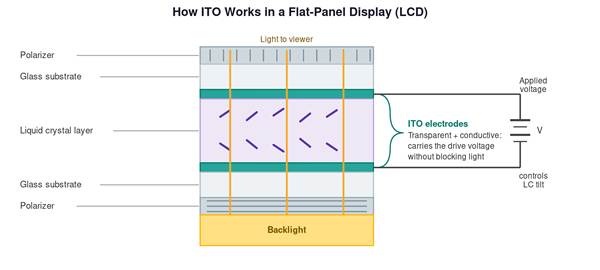
This unusual combination of transparency and conductivity allows ITO to function as a transparent electrode rather than merely as a coating. In a typical flat-panel display such as a liquid-crystal display (LCD), ITO is deposited as a thin film—typically 100 to 300 nanometers thick—on the inner surface of each glass substrate, forming transparent electrodes on either side of the liquid crystal layer, as shown in Figure 1.
In a metal, essentially all conduction electrons are free to move, but they also strongly absorb visible light, making the metal opaque. In ITO, only a relatively small fraction of electrons—those donated by the tin dopant—are free to conduct. This concentration is high enough to provide useful electrical conductivity but still low enough that visible light passes through with little absorption.

The image above shows a simplified cross-section of an LCD panel, showing the two ITO electrode layers sandwiching the liquid crystal between glass substrates and crossed polarizers, with the backlight and applied-voltage circuit that drives each pixel.
Applying a voltage across the two indium tin oxide layers reorients the liquid crystal molecules between them; combined with the crossed polarizers, this determines how much light from the backlight reaches the viewer at each pixel. An opaque metal electrode could perform the same electrical function, but it would block the light path entirely. Because ITO is both transparent and conductive, it can carry that drive voltage while remaining invisible to the viewer — which is precisely why it, rather than a conventional metal, became the standard electrode material for flat-panel displays.
The Role of Tin Doping in Electrical Conductivity
Pure indium oxide would actually be a rather poor conductor. The trick is adding a small amount of tin: tin atoms replace some of the indium atoms in the crystal lattice, and each tin atom contributes an extra electron that is free to move through the material. These extra electrons dramatically increase electrical conductivity.
The tin concentration is carefully controlled — enough to conduct electricity, but not so much that the extra electrons begin to absorb visible light. This delicate balance gives ITO its unique combination of transparency and conductivity.
Why Graphene Has Not Replaced Indium Tin Oxide
Whenever graphene is mentioned, people often ask why it has not replaced ITO. Graphene is an extraordinary material: a single layer of carbon atoms arranged in a honeycomb lattice that is stronger than steel by weight, highly flexible, nearly transparent, and an exceptionally good electrical conductor. Unlike ITO, which is a doped semiconductor, graphene behaves much more like a metal because it has essentially no electronic band gap. Electrons can move through graphene with remarkable ease, giving it one of the highest carrier mobilities of any known material.
Graphene faces a fundamental engineering tradeoff. A single layer absorbs only about 2.3% of visible light and is therefore nearly transparent, but its sheet resistance is too high for most touch screens and displays. Reducing the resistance generally requires adding additional graphene layers or chemical doping. Multiple layers reduce transparency, while chemical doping often compromises long-term stability and increases manufacturing complexity. As a result, achieving both the extremely low sheet resistance and the very high optical transparency required for modern displays has proven far more difficult than originally anticipated.
Manufacturing Maturity as a Competitive Advantage
Beyond its physics, ITO has a substantial practical advantage: manufacturers have spent more than three decades perfecting methods for depositing thin ITO films over enormous sheets of glass. These processes are highly reliable, extremely uniform, relatively inexpensive, and capable of producing millions of displays every month.
Replacing such a mature manufacturing ecosystem is extraordinarily difficult. Even if another material performs slightly better in the laboratory, it must also prove that it can be manufactured just as consistently and economically before it can compete with ITO commercially.
Conclusion
Indium tin oxide is one of the unsung heroes of modern technology. Its unique electronic structure allows visible light to pass almost unhindered while a carefully engineered population of free electrons carries electrical current — a rare combination that makes possible the touchscreens, flat-panel displays, and solar cells that define modern electronics. If you are interested in ITO, reach out to our support team for more information.