乡亲们
遗憾 冰人厄齐约公元前 3500 年。人们认为他参与了铜的冶炼,因为在他的头发中发现了铜微粒和砷,砷是某些铜矿石中的微量元素。他不仅被砒霜慢慢毒死,而且为了冶炼铜,他必须将柴火的温度提高到大约 1085ºC (1985ºF),这在我上一篇文章中已经讨论过。 上一篇文章.铜中含有砒霜确实有好处,因为它使铜的强度比纯铜更高一些。
在奥齐时代之后不久,金属工人发现在铜中加入 10%的锡就能制成青铜。青铜不仅硬度明显高于铜,而且熔化温度比纯铜低近 100ºC,使金属加工变得更加容易。青铜时代 青铜时代开始了。这一时期恰好是学者们公认的现代文明的开端,如埃及和希腊。
由于青铜的熔化温度较低,因此也能更好地填充模具。从图 1 中可以明显看出这种模具填充性的改善。这张照片展示的是我制作的一把铜制和青铜制的斧头。左边的铜斧显示出模具填充不良的迹象。
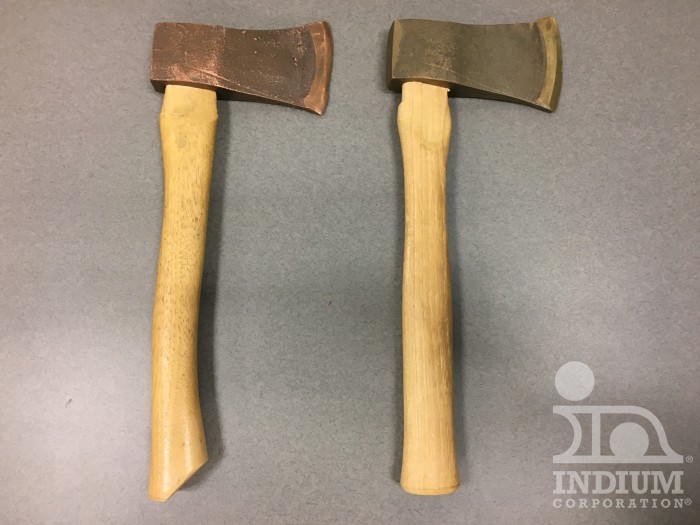
图 1.左侧是铜制,右侧是为罗恩博士制作的青铜斧。 达特茅斯学院课程 工程学 3:材料:文明的实质。请注意,由于铜的熔化温度较高,铜斧的模具填充性较差。
我认为,几乎可以肯定青铜时代与焊接技术的发展有关。最早的 焊接的证据大约是公元前 3000 年,在那里,可以说是第一个文明,苏美尔人 苏美尔人他们用高温焊料组装剑。由于大多数铜对铜焊接的基本金属是锡,早期的金属工人几乎可以肯定,锡可以用来在比熔炼温度低得多的温度下将铜或青铜碎片连接在一起。
Until the European Union’s restrictions on lead in solders in 2006, most electronics solders were tin-lead eutectic. Eutectic is a Greek word that roughly translates into “easy melting.” Figure 2 shows the tin-lead phase diagram. Note that the melting point of tin is 232ºC and that of lead is 327ºC, yet at the eutectic concentration of 63% tin/37% lead, the melting temperature drops to 183ºC. This concentration and temperature is known as the eutectic point.
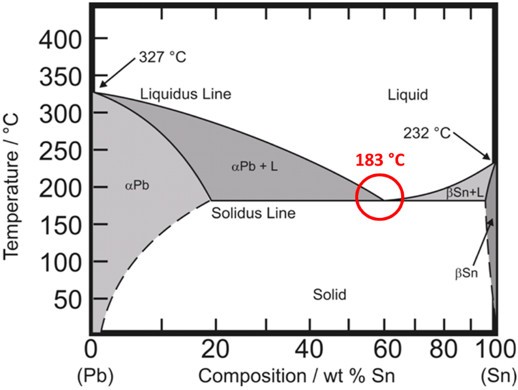
图 2.锡铅相图 锡铅相图.注意 183ºC 的共晶点。
After the EU’s lead restriction went into effect, most electronics solders are based on a tin-silver-copper alloy that melts in the 217-225ºC range. The most common of these alloys being SAC305 (Sn96.5Ag3.0Cu0.5, where the numbers are weight percentages.)
Although the eutectic point is an interesting and usually beneficial phenomenon due to its lower melting point, the true miracle of soldering is that two pieces of copper that melt at 1085ºC can be bonded together with a tin-based solder at less than 232ºC. The value of this benefit cannot be overstated. Nature has allowed us to mechanically and electrically bond two pieces of copper together at a low enough temperature that we can do this bonding in the presence of electrically insulating polymer materials. Without this feature of solder, we would not have the electronics industry! An added benefit is that the bonding is reworkable, so that if a component fails, it can be replaced without scrapping the entire electronics printed circuit board.
It is natural to ask how this bonding takes place. The tin in the solder forms intermetallics with the copper. Typically Cu6Sn5 forms near the tin and Cu3Sn forms near the copper. See Figure 3.

图 3.铜锡金属间化合物,摘自 Roubaud 等人,"IM 生长对无铅组件机械强度的影响",APEX 2001。影响",APEX 2001。
因此,下次当您使用智能手机、笔记本电脑、平板电脑或其他电子设备时,不要忘记,如果没有焊接这一奇迹,这些设备就不会存在。
干杯
罗恩博士