乡亲们
One of the great challenges of tin whiskers is detecting them. When one considers that their median thickness is in the 3 to 5 micron range (a human hair is about 75 microns,) they can be hard to see with direct lighting. Right angle lighting facilitates visual detection. See Figure 1. In this figure, Panashchenko shows that with direct light (left image), it is impossible to see the tin whisker, however with right angle light the tin whisker jumps out.
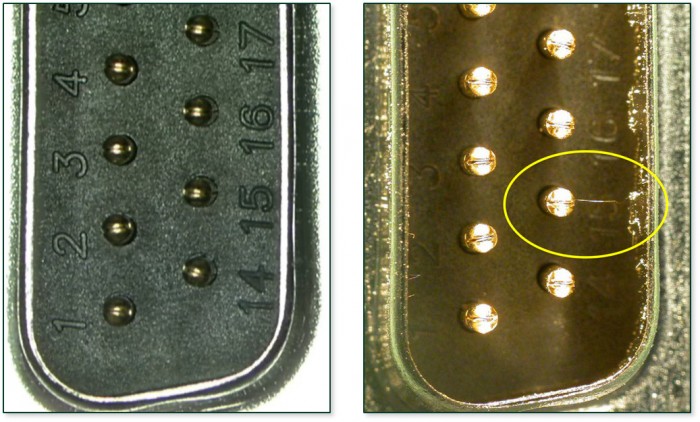
图1. 如同左图所示,直接照明无法观察到锡须。然而在右图中,直角照明使锡须清晰可见。 该图像引自Panashchenko, Lyudmila(2012年4月)《金属须检测技术:电子专业人士实用指南》,IPC锡须会议,德克萨斯州达拉斯,第41-42页。
在题为《金属须检测艺术:电子专业人士实用指南》的精彩演讲中,帕纳申科提出了以下使用立体光学显微镜识别锡须的技巧:
- 使用3倍至100倍立体显微镜
- 从低倍放大开始,逐步过渡到高倍放大
- 能够在三个轴向倾斜样品
- 使用可调节角度的柔性灯具,避免使用环形灯。
- Use a LED or fiber optic lighting, not incandescent lights which can cause shadowing
- 改变光源的亮度
最重要的技巧是在改变放大倍数的同时调整照明角度。因此,分析一个样本至少需要几分钟时间。然而,即使是最彻底的检查也可能遗漏某些锡须。
在下一篇文章中,我将探讨缓解技术。
干杯
罗恩博士