Ask someone to name the materials essential to modern technology and they will probably mention silicon, copper, lithium, or perhaps rare-earth elements. Almost no one will mention gallium.
Yet gallium has quietly become one of the most important materials in advanced electronics. It helps generate the radio-frequency signals in smartphones and radar systems, enables highly efficient power electronics, produces brilliant LEDs and semiconductor lasers, and is becoming increasingly important in electric vehicles, data centers, satellite communications, and high-power electrical systems.
The interesting question is: Why gallium?
Gallium Is an Unusual Metal
Gallium (Ga), atomic number 31, is a soft, silvery metal with one particularly memorable property: it melts at only about 29.8°C (85.6°F). A piece of gallium can literally melt in your hand. See Figure 1.
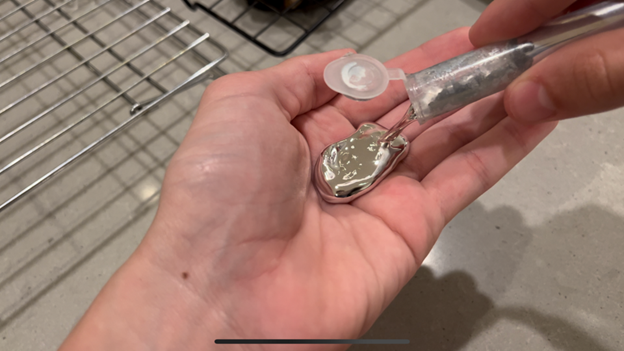
Gallium melting in your hand. Photo: Andrew DaGamer, Wikimedia Commons, CC BY-SA 4.0.
Its boiling point, however, is extraordinarily high—over 2,200°C. That enormous liquid temperature range is one reason gallium and gallium-based alloys are interesting for specialized thermal applications.
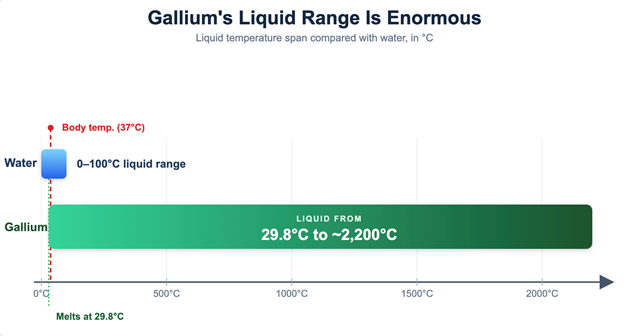
Gallium stays liquid across an unusually wide temperature span — from just below body temperature to well over 2,000°C.
But gallium’s greatest importance does not come from metallic gallium itself. It comes from the remarkable semiconductor compounds that gallium forms with other elements.
Two are especially important: Gallium arsenide (GaAs) and gallium nitride (GaN). These materials can do things that ordinary silicon cannot do nearly as well in the realm of semiconductors.
Gallium Arsenide: When Silicon Isn’t Fast Enough
Silicon dominates conventional electronics for good reasons: it is abundant, inexpensive, well understood, and supported by an enormous manufacturing infrastructure. But silicon is not always the best semiconductor, because in some applications electrons move too slowly through it.
However, electrons can move extremely rapidly through gallium arsenide, much more so than in silicon. This makes GaAs particularly valuable for high-frequency and radio-frequency electronics.
GaAs has therefore found important applications in smartphone RF amplifiers, radar, satellite communications, microwave electronics, and high-frequency wireless systems, as well as high-efficiency solar cells, particularly for spacecraft.
GaAs is also a direct-bandgap semiconductor. That seemingly obscure bit of semiconductor physics is enormously important. Silicon is very good at processing electrical signals, but relatively poor at converting electricity directly into light. GaAs and related gallium compounds can perform this conversion efficiently.
That brings us to one of gallium’s greatest contributions.
Gallium Helped Create the LED Revolution
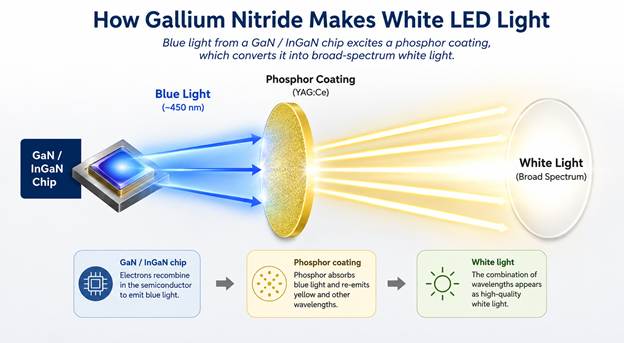
Modern high-brightness LEDs depend heavily on gallium-containing compound semiconductors. Gallium nitride and related materials such as indium gallium nitride (InGaN) enable efficient blue LEDs. Once practical blue LEDs became available, they could be combined with phosphors to produce white light. See Figure 3.
Top of Form
Bottom of Form
A phosphor coating converts a GaN-based blue LED’s output into the white light used in general lighting.
The result was revolutionary. LED lighting consumes much less electricity and lasts dramatically longer than incandescent lighting. About 5% less electricity is consumed for lighting as a result of LED lights. This amount of electricity is greater than all data centers are projected to use into the mid 2030s. Gallium-containing semiconductors have therefore contributed to enormous worldwide energy savings.
The same basic semiconductor physics also makes gallium compounds important in laser diodes, which are used in optical communications, industrial systems, displays, sensing, and many other applications.
Gallium Nitride Is Also Transforming Power Electronics
Perhaps the most exciting modern application of gallium is gallium nitride (GaN) in power electronics.
GaN is a wide-bandgap semiconductor. Its bandgap is about 3.4 eV, compared with about 1.1 eV for silicon.
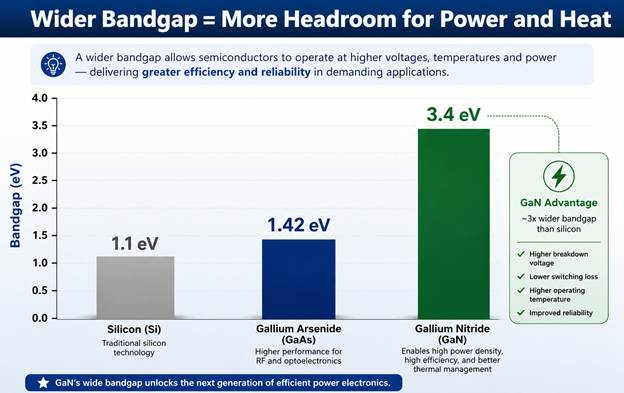
The chart above shows a wider bandgap that lets GaN devices handle higher voltages and temperatures than silicon or GaAs.
That difference gives GaN some remarkable capabilities. GaN devices can operate at high electric fields, switch extremely rapidly, tolerate high temperatures, and achieve very high power densities.
For power electronics, faster switching can mean smaller transformers, inductors, capacitors, and cooling systems.
Anyone who has noticed how surprisingly small some modern high-power USB-C chargers have become has seen one practical consequence of GaN technology. A charger that once required a relatively bulky silicon power supply can now be made much smaller and more efficient.
GaN power electronics are increasingly attractive for data-center power supplies, electric vehicles, solar power systems, and telecommunications, along with aerospace electronics, industrial motor drives, and high-frequency power conversion more broadly.
As society electrifies more equipment and consumes more computing power, even small improvements in power-conversion efficiency become enormously important.
Gallium and Artificial Intelligence
The rapid expansion of AI has created another reason to pay attention to gallium.
Modern AI data centers consume tremendous amounts of electrical power. Before electricity reaches an AI processor, it may pass through several stages of voltage conversion. Every conversion creates some loss and heat.
Improving power conversion by even a few percentage points can become significant when thousands of high-power processors are operating continuously.
GaN power devices can enable higher-frequency, higher-efficiency and more compact power conversion. Gallium therefore may play an increasingly important supporting role in the infrastructure behind AI—not necessarily inside the main processor itself, but in efficiently delivering power to it.
Gallium-based RF devices are also important in the communications infrastructure connecting our increasingly data-intensive world.
Gallium Has a Thermal Side, Too
Gallium has another unusual characteristic that is attracting attention: because it melts near room temperature, gallium-based alloys can be used as liquid-metal thermal interface materials (TIMs). Indium Corporation’s GalliTherm® family is an important example of these materials.
A TIM fills the microscopic gaps between a heat-generating semiconductor package and a heat sink or cold plate. Conventional polymer-based TIMs generally conduct heat much less effectively than metals.
Gallium-based liquid-metal TIMs can offer thermal conductivities on the order of tens of W/m·K while conforming intimately to mating surfaces. This combination can produce very low thermal resistance.
There are challenges. Gallium is chemically aggressive toward some materials—aluminum is a famous example—and containment, wetting, corrosion, and long-term material compatibility must all be carefully engineered.
Nevertheless, as semiconductor heat fluxes continue to increase, gallium-based TIMs are an intriguing tool for thermal engineers.
Why Is Gallium So Special?
There is a fascinating theme behind gallium’s importance.
Gallium sits in a particularly useful part of the periodic table. When combined with Group V elements such as arsenic and nitrogen, it forms III-V compound semiconductors whose electronic structures can be tailored for properties that silicon cannot easily provide.
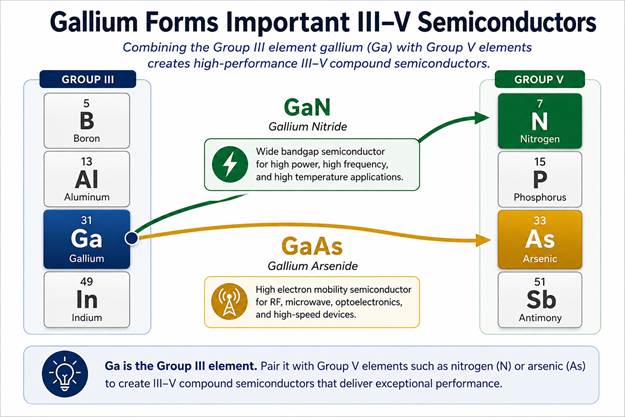
Gallium (Group III) paired with arsenic or nitrogen (Group V) produces the compound semiconductors behind GaAs and GaN devices.
Combine gallium with arsenic and we obtain exceptional high-frequency electronic and optoelectronic properties.
Combine it with nitrogen and we obtain a wide-bandgap semiconductor capable of handling high fields and high power while switching extremely rapidly.
Combine gallium with indium and nitrogen, and we obtain materials whose bandgaps can be engineered for LEDs and lasers.
Use gallium itself—or carefully designed gallium alloys—and its low melting point opens another world of liquid-metal and thermal-management applications.
So gallium is not important because it does one thing extraordinarily well.
It is important because its unusual chemistry and physics allow it to solve several of the hardest problems in modern electronics: generating light, handling high-frequency signals, efficiently controlling electrical power, and managing heat.
Silicon will remain the foundation of electronics for the foreseeable future. But as electronics become faster, hotter, more powerful, and more energy intensive, engineers increasingly need materials that can go where silicon cannot.
Gallium is one of those materials.
For an element that most people have never heard of, it carries a surprisingly large share of the modern technological world on its shoulders. For more information about how Gallium can support your products, reach out to one of our experts for more information.