乡亲们
为电子产品散热的挑战几乎与拥有百年历史的电子工业一样古老。在现代电子产品中,大部分热量都是由集成电路 (IC) 产生的,必须将这些热量带走,否则 IC 的寿命就会很短。这一热传导难题通常是电子设计中的一个限制性问题。
In many cases the thermal path or the path that the heat must travel from the integrated circuit to the heat removing fins is a critical design challenge. In its simplest form, the thermal path is from the IC chip through a thermal interface material (TIM) to the heat removing heat sink as shown in Figure 1. Other thermal paths exist, but are similar in the movement of heat. Examples are burn-in and thermo-electric cooler applications.
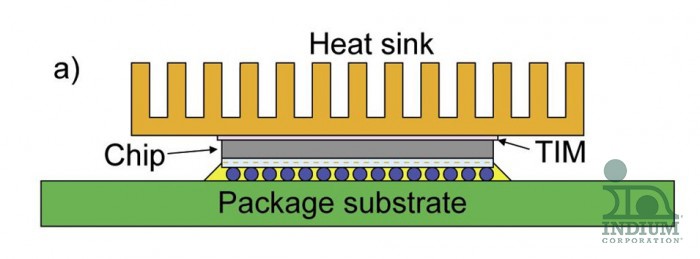
图 1.集成电路最简单的热路径如上图所示。TIM 是该热路径的关键部分。
虽然 TIM 的概念初看起来似乎微不足道,但开发一种成本低、效率高、装配工艺简单的 TIM 却是一项长达数十年的挑战。为了有效去除集成电路中的热量,TIM 必须与集成电路和散热器的表面相吻合,并将散热器与集成电路粘合在一起。如果 TIM 材料留有空气间隙,热路径就会变差,集成电路就会过热。
Thermal grease has been used as a TIM for years, but has the disadvantage of being a poor conductor of heat and often the process of applying the thermal grease is messy.
A new product has been developed to meet the TIM challenges. It is a thin foil of aluminum, one of the best conductors of heat, coated with a non-silicone thermal compound. This TIM not only has excellent thermal conductivity, but is easy to apply. The new TIM has already been successfully deployed in some burn-in and thermoelectric cooling applications.
干杯
罗恩博士