This is the last in a series of posts that discusses reinforced Solder Preforms for high–reliability and low voiding. This post will focus on the results of our DOE to find out if we did, in fact, Avoid The Void®.
When analyzing the voiding data from the DOE, there were some clearly identifiable differences among the reinforced solder preform designs. A summary of the data is shown below.
对于间距类型,前两个字符(LM 或 SM)指的是间距量。后两个字符指的是间距量(04 为 0.004 英寸,08 为 0.008 英寸)。所有设计的平均空隙率均小于 10%!其中五项设计的数据点均未超过 10%。进一步分析确定了特定属性的重要性。在这种统计分析中,如果 P 值小于 0.05,则至少有一个因素的平均值存在统计差异。
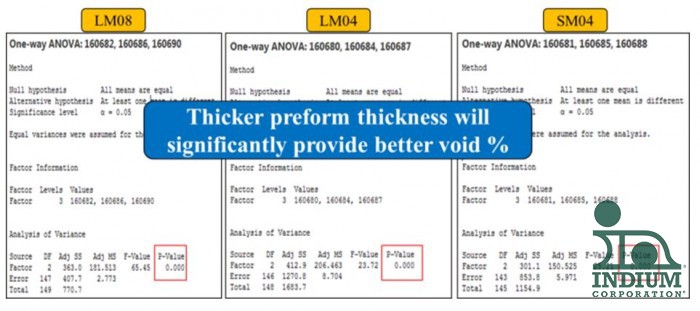
When looking at the impact of overall preform thickness, we isolated the type of stand-off; therefore, we looked at LM04, LM08, and SM04 data sets separately. In every case, a higher overall preform thickness resulted in less voiding. The summary of this analysis is shown in below.
由于表面张力的作用,空隙会从熔融焊料中逃逸出来,迫使它们向周边移动。熔融焊料中未熔化的金属可能会阻碍这些空隙逸出的通道。如果有更多的焊料,空隙就能在焊点完全塌陷之前从金属基体周围逸出。
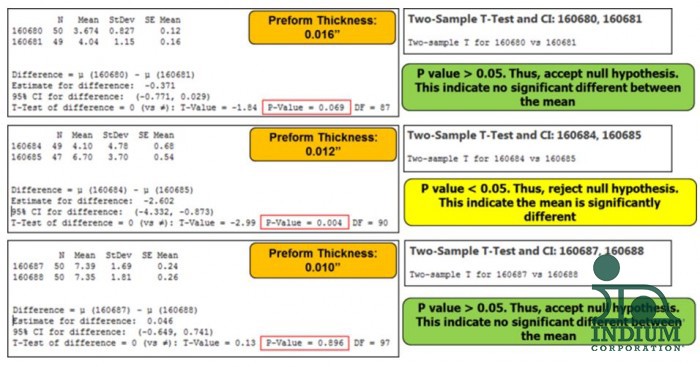
When exploring the packing density of the stand-off material, the void differences between SM and LM were examined individually for each overall preform thickness. This analysis is summarized below.
The results here are not as clear. For the 0.016″- and 0.010″-thick preforms, the packing density did not significantly impact the void performance. For the 0.012″ thickness, the SM product was statistically better than LM. Based on these results, it cannot be conclusively stated that packing density has any influence on voiding. The data suggests that, at most, this factor would only be a minor contributor to voiding.
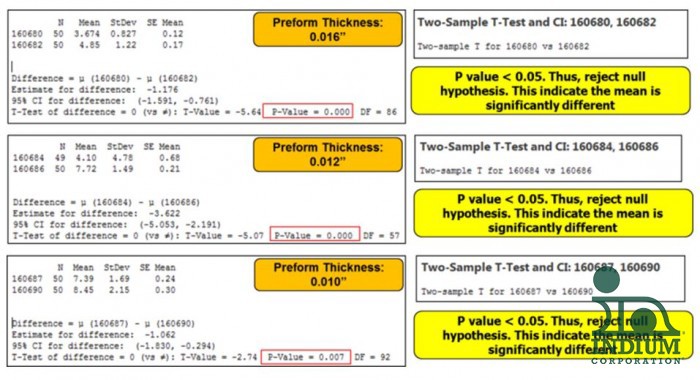
The thickness of the stand-off was also examined. In this case, LM04 was compared to LM08 for each of the preform thicknesses. For every preform thickness, the higher stand-off (08) always resulted in statistically significant higher voiding. This also can be explained relative to the solid stand-off material impeding the escape of the voids. Because the 08 material is thicker, there would be more overall volume of stand-off metal embedded into the preform versus the 04 material. More solid material has the potential to impede the ability of the voids to escape the molten solder. A summary is below.
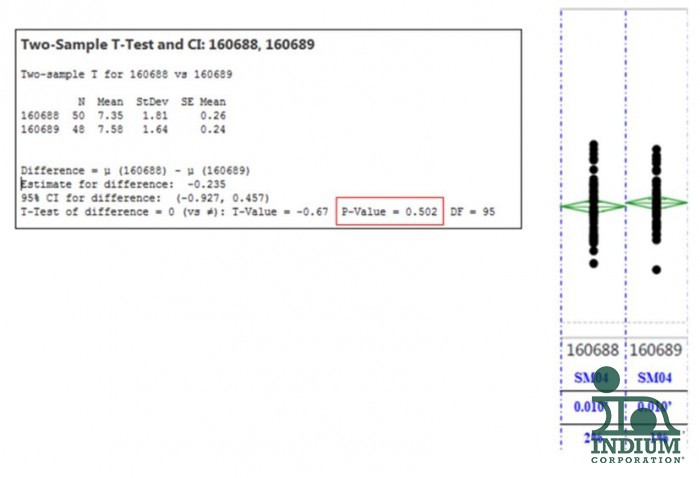
The final parameter analyzed in this study was flux percentage. Based on the chemistry of oxide removal and volatilization, it is expected that more flux will result in more voiding. Basically, as the product goes through reflow, the flux removes the oxides on the metal surfaces. That oxide removal process creates some vapor. Additionally, there are non-active ingredients in the flux that will volatilize at elevated temperatures. Both of these flux attributes could result in vapor getting entrapped in the molten solder. However, the work in this study did not show any significant difference between 1% and 2% flux. It can only be speculated that perhaps the 1% difference in flux was not enough to impact the voiding. This is an area where further work could be done.
In summary, studies done on reinforced solder preforms show that they can help to improve the reliability of solder joints by providing a consistent solder joint bondline. The work also shows that the final thickness of the preform, the packing density of the stand-off material, and the thickness of the stand-off all can be adjusted to impact the amount of voiding in the solder joint. Through an optimized design of the reinforced preform, it is clear that this technology can produce high-reliability, low-voiding solder joints. This technology is probably more necessary when dealing with heavier components in which solder joint collapse could be excessive if not controlled. This technology, which builds in the stand-off without incurring additional process steps (such as wire bond stitching to control the collapse of the solder) can save time and money for assemblers.
下次再见
亚当