Had some very interesting conversations at the IWLPC show last week, as always: one discussion was with my good friend Jeff Schake of Dek. He knew I had done some work a few years ago on a system for preventing solder paste drying out on the stencil by maintaining a set solvent vapor pressure, or “%RS” (the solvent equivalent of a %RH) over the paste.
几乎作为我工程工作的副产品,我意识到我需要一种工具来区分正在失去溶剂的焊膏和仅仅由于随时间变化的流变(TDRC)而 "变稠 "的焊膏。TDRC 包括触变和流变等现象。触变或剪切变稀现象,对于曾经摇晃过番茄番茄酱玻璃瓶以让瓶子里的番茄酱流出的人来说并不陌生:番茄酱具有弱凝胶状 "结构",只需简单摇晃就能将其分解为低粘度结构。分解这种 "结构 "所需的(延缓)时间可以用一个简单的指数函数来模拟,该函数基于半衰期的流变学等价物,(松弛)时间也是如此。这里的 "松弛 "是指锡膏在没有剪切力的情况下静置一段时间后凝胶结构的重建,其重建速度仅取决于扩散动力学--[以防您在阅读本博客的标题时脑海中浮现出锡膏在棕榈滩的沙滩上晒黑的画面]。
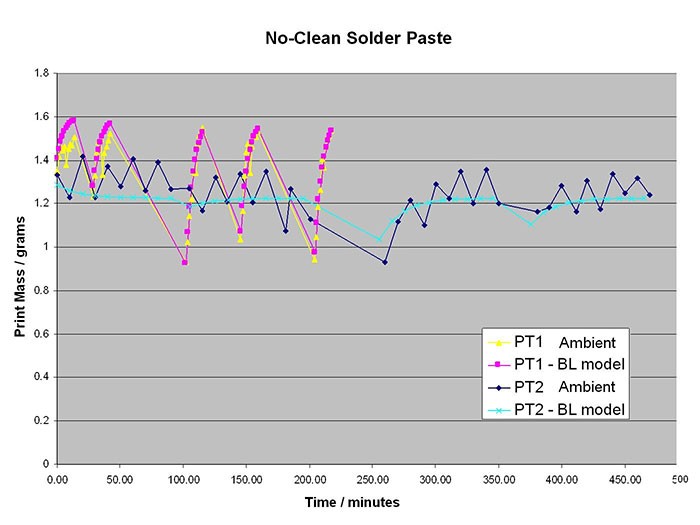
The no-clean solder paste studied certainly did change in viscosity with time, but the change was reversible, fitting the rheological model rather well (data shownbelow) but demonstrating that irreversible drying (solvent loss) was NOT the prime cause of the stencil clogging and other problems seen.
Contrast this with the water-wash paste (data shown below), which even after a couple of hours showed signs of irreversible performance degradation that could be prevented by maintaining a controlled atmosphere as a specific %RS over the paste surface during its stencil-life.
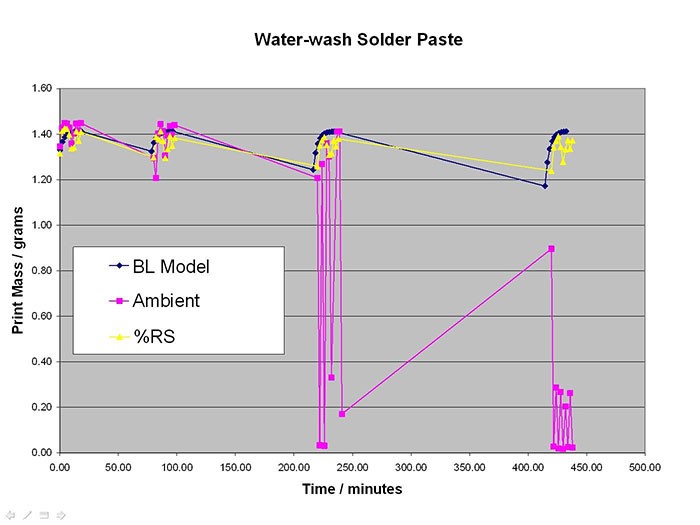
Most no-clean pastes these days require little or no kneading (stirring or printing on the stencil) before they are used, but as a rule of thumb: the more kneading a paste requires before it is useful – the less time it can be left on the stencil between prints.
Mechanistic insights like this are also helping us to develop improved wafer-bumping and flip-chip solder pastes.
干杯安迪