乡亲们
Let’s assume your company has decided that transfer efficiency (TE) is the key metric in determining solder paste quality. Transfer efficiency is the ratio of the volume of the solder paste deposit divided by the volume of the stencil aperture. While you agree that TE is an important metric, you are a little troubled with the recent results in a solder paste evaluation. Two out of 10 pastes are fighting for the top spot and it looks like TE will be the deciding metric. Paste A had a TE of 99.5% and Paste B had a TE of 99%. So management wants to go with paste A. You are troubled because paste A has a poor response-to-pause. If it is left on the stencil for 15 minutes or more the first print must be discarded. This weakness may result in 30 minutes or so of lost production time in a 3-shift operation.
然而,TE 测试结果表明,从统计学角度看,浆糊 A 的 TE 明显优于浆糊 B。仔细想想,这种情况有些不合理........99.5% 和 99% 非常接近。
你拿起统计教科书,复习假设检验。然后你会发现,在样本量非常大的情况下,越来越接近的均值在统计学上会有显著差异。
The data show that paste A has a mean of 99.5% and a standard deviation of 10%, whereas paste B has a mean of 99% and also a standard deviation of 10%. The sample sizes were 10,000 samples each. These large sample sizes are important in the analysis. The standard error of the mean (SEM) is used to compare means in a hypothesis test. SEM is defined as the standard deviation (s) divided by the square root of the sample size (n):

因此,随着样本量的增加,SEM 也会变小,用统计学术语来说就是 "更紧密"。在样本量非常大的情况下,这种紧密度能够在统计学上区分越来越接近的平均值。这种情况在样本量少于 100 个的情况下并不存在,但在当今的现代焊膏量扫描系统中,样本量超过 1000 个是很常见的。
Figure 1 shows the expected sampling distribution of the mean for samples with a TE of 99.5% and 99.0% and a sample size of 100, both have a standard deviation of 10%. Note that to your eye you do not see much difference. However, with the means and standard deviations the same and sample sizes of 10,000 the sampling distributions of the mean are clearly different in Figure 2.
但实际情况是,图 1 和图 2 的结果并没有什么不同。平均值的微小差异(0.5%)在 10,000 个样本量的情况下可能具有统计学意义,但实际意义大吗?在生产环境中,这种微小的差异真的重要吗?几乎肯定不会。
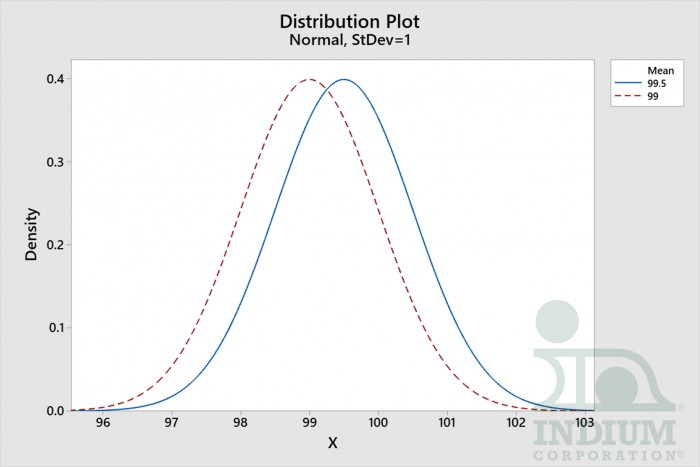
图 1.100 个样本的平均值抽样分布。
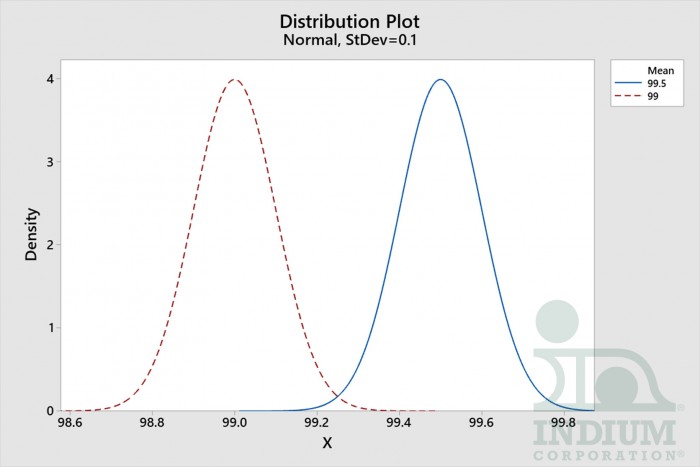
图 2 10,000 个样本的平均值抽样分布。
因此,在样本量较大的情况下,我们需要扪心自问,这种差异是否具有实际意义。就 TE 而言,我认为我们可以确信,0.5% 的差异没有实际意义。但是,如果差别是 2% 或 5%呢?显然,我们应该通过实验来确定在什么水平上的差异是显著的。
With the case discussed above, I would much prefer the paste that has a 99.0% TE and a good response-to-pause.
干杯
罗恩博士