An Introduction
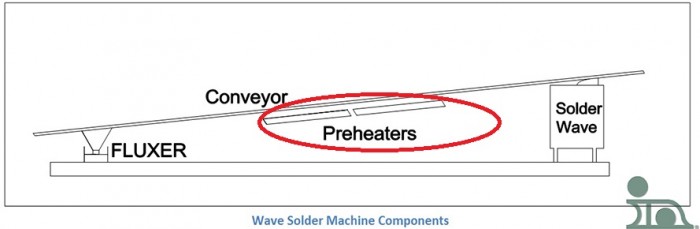
Many of my posts have been discussing the different types of wave soldering fluxers: their capabilities and their shortcomings. This series will be similar, except preheaters will be discussed. But first, a quick introduction.
The definition of preheating is the practice of applying heat to a PCB after flux deposition and immediately before soldering. Wave soldering can be performed without preheating, but the soldering speed will be slow. The age-old saying that “time is money” emphasizes the need for preheating. In The Handbook of Machine Soldering SMT and TH, Woodgate mentions, “During some experimental work with preheating, a board was soldered at 12 ft. per minute with the normal preheat applied. Without preheat it could not be soldered faster than 2.5 ft. per minute.” Just because a joint can be formed without this process doesn’t mean that it should.
预热的理由几乎都是
- 通过加热 "激活 "助焊剂
- 通过干燥助焊剂溶剂来防止焊球,否则助焊剂溶剂在只接触焊波时就会喷溅出来
- To reduce thermal shock to the PCB from the solder wave, thus decreasing warping and other defects associated with an abrupt increase in temperature
The most important reason to use preheat is to “heat the board, components, terminations, and other parts of the joint so that the final heating and soldering can proceed more quickly.” By minimizing the exposure to the molten solder, damage to the components can be minimized as well.
Types of Preheaters
I mentioned, in the previous part, that preheating is needed to decrease wave soldering cost. With trying to decrease the cost of the wave soldering process there have been many different types of preheaters that have been developed, each with advantages and disadvantages. The most commonly used forms of preheaters are:
- The electrically heated hot plate or platen
- Tubular electric (Cal Rod)
- Hot air
- Quarts plate
- Quarts rod
- Ceramic
- Infrared
- Focused ocular solar radiation
- *Note* There is only one person with the capability to do this and it is extremely rare. He is also “faster than a speeding bullet! More powerful than a locomotive! Able to leap tall buildings at a single bound!” I am of course talking about the man of steel, Superman. One of his powers is heat vision. This would be a an ideal method of preheating boards because it only requires the presence of the man of steel.
All of these will be discussed in the coming weeks (with the exception of the kryptonian).
These are the questions that an operator needs to ask themselves when trying to choose the appropriate preheater for their process:
- Are you worried about the cost of electricity and energy efficiency?
- Do you need to heat and cool very fast? If so, a small thermal mass would be ideal.
- How will it be cleaned? Is a self-cleaning feature attractive?
- How long will you be using the same preheater? You don’t want it to decrease its thermal output with age.
Unfortunately a preheater that addresses all of the above questions does not exist. We are all waiting anxiously for one to be invented. Most of the preheaters mentioned will only have one or two of the features listed. I will show you the features of each of these preheaters in the coming weeks.
Hot Plate or Platen
The previous section introduced all of the different type of preheaters. The Hot Plate or Platen preheater will be the first type I will discuss.
If you are looking for a low-cost option for preheating, the Hot Plate or Platen preheating is the way to go. The preheater consists of an iron plate with strip heaters bolted on the underside, protected by a metal cover. A schematic can be seen below.

The strip heaters are normally positioned parallel to the board motion in the conveyor. In this instance the board would be traveling perpendicular to the screen. The benefit of this is that some of the heaters can be turned on or off based on the width and size of the board being soldered. This can conserve power when needed, and heat more effectively in other instances. The steel plate has to be thick enough to provide even heating. So the power savings are marginal at best.
Advantages
- Virtually self-cleaning: any buildup of residues will burn off and not affect the heating capabilities
- Unaffected by minor environmental changes (such as opening the machine doors)
- High Thermal Mass
- Low cost
Disadvantages
- Inefficient use of electrical energy
- Requires considerable time to reach a steady temperature
This type of preheater is ideal if the soldering parameters do not change much during production. Waiting for the plates to reach equilibrium can become a problem in the assembly process because, when a machine is not operating the line stops. A way to mitigate this problem is to adjust the conveyor speed for the different sized boards. This will, however, create a situation where there is a compromise between throughput speed and preheat temperature. This compromise will be ideal compared to waiting for the preheaters to change temperatures unless the assemblies are tightly packaged, or the assemblers are using multilayer boards.
Calrod®: Wave Soldering
The last section was about the benefits and disadvantages of using a platen or hot plate preheater in wave soldering. There are many different kinds of preheating. Calrod® preheating has a much faster response time than its plate or platen cousin. A Calrod’s physical structure consists of tubular elements that operate near red-heat temperatures, meaning that the elements can glow red when operated in certain conditions. It is the same technology that is used on electric ranges. These elements are used to indirectly heat the PCB through the use of a reflector that is usually contained in the frame to which the elements are bolted. A diagram of the elements can be seen below. The benefits of using a calrod preheater are:
- They are very durable and won’t break when moving or adjusting the equipment in which they are installed.
- They can last for a long time.
- They heat quickly and can be regulated without expensive or complex machinery.
- They are designed to be used in a large number of applications.
The efficiency of this type of preheater is cleanliness dependent, meaning that the rods and reflector need to be kept clean in order to work properly. Having flux drip on the elements or the reflector will cause the flux to char and could lead to inadequate heating, which may lead to inadequate soldering. According to The Handbook of Machine Soldering SMT and TH by Ralph Woodgate there is a, “common practice to line the reflector with aluminum kitchen foil. When this becomes discolored it is replaced with a fresh sheet.” This assures consistent heating of the assembly. If the calrods are operated at a high enough temperature they can be self-cleaning.
The calrod preheater can operate at a higher temperature than the hot plate and doesn’t require a long preheater section to arrive at the same board temperature. Always be sure that, when using SMT components, you follow the component manufacturer’s specs and recommendations.
Hot Air
It makes sense that this was, most likely, the first form of preheating which would have been used to dry rosin-based fluxes that were popular in the past. Hot air removed the solvents (mainly alcohol), but didn’t heat the actual PWB very well. The heat transfer efficiency between the air and the board was low when open to the surroundings and, thus, preheated poorly.
The outcome is different if you place this same system in an enclosure. The energy is able to heat the board. Correctly implemented, this form of preheating can produce more even heating than most of the direct radiation systems alone. Therefore, it is common to couple the hot air preheater with another heating method.
Quartz Plate
We continue our discussion of solder reflow methods.
As the name suggests, quartz plate preheaters have thick quartz plates in which the heating elements are embedded via pockets or slots. The heating and cooling rates are very fast compared to other preheaters – up to 93°C per minute. Because these elements get so hot so quickly, they do not require a secondary cleaning step. Any flux that drips down onto the plate will burn off. Like Hot Platepreheaters, the quartz plate can be arranged in sections parallel to the conveyor so that they can accommodate a variety of board designs.
The fast heating and cooling rates require a sophisticated control system which makes it more expensive than the alternatives. A word of caution – if this plate is left unattended it can overheat resulting in irreparable damage to the preheater. The quartz plate is also sensitive to abuse, such as a PWB falling onto the surface, or careless handling. More complex (multi-layer, high thermal mass) assemblies need adequate heating, which in other systems would require a very long preheat. It is unlikely that such a system is going to be built into a wave solder machine.
Quartz Tube
As a follow up on quartz plate preheaters for wave soldering, this section is dedicated to the very similar quartz tube preheater. If you remember, one of the advantages of using a quartz plate was that it had one of the fastest response times; however, quartz tubes have even faster response times.
The heating elements are placed inside the quartz tubes along with the thermocouples. The tubes can be quite fragile and, if items fall on them, they are likely to crack or break. One advantage, however, is that each tube can be turned on or off individually. This is beneficial if they are installed parallel to the conveyor because they will provide even heat no matter how wide the board is. If the conveyor system has a fixed width, they can be mounted perpendicular to the rails and be switched on or off individually to provide the required amount of preheat. If your wave soldering machine has the option for an automated and computer-controlled system, or has a fixed width, then these versatile preheaters are what you would want to use. It is common to couple the quartz tubes with hot air by either forcing heated or ambient air through the tubes. This is one of the more attractive options for technicians who do not have excess space in which to place a preheater.
Lamp-Type Infrared and Ceramic Plate
Lamp style preheaters have the fastest response time of any of the previous preheaters mentioned in other posts. The lamp filament is practically the sole thermal mass; it is so fast that the response time is measured in seconds rather than minutes, as with the other models. This type of preheater can reach peak temperatures that are exceptionally high as long as there is an advanced control system. If the control system is not available it could cause damage to the board.
Unfortunately, these lamps can be on the expensive side because they often have a gold-plated reflector which may require water cooling. The units are also very fragile and need to be kept impeccably clean. If dirt or flux gets on the lamps, there is a high risk of scratching them during the cleaning process, which would cause permanent damage.
Ceramic plate heaters are not commonly used either. The heating rates and design are almost identical to quartz plate preheaters. The response time is quick because the electrical elements along with the thermocouples are embedded into surface of the plate. This ensures a smooth and easily cleanable surface. They are also resilient and can withstand possible damage by falling boards.
Heating, Wavelength, and Infrared
As I mentioned in the previous section, the goal of preheating, regardless of method used, is to increase the metallic structure of the joint to a specified temperature. It would be ideal if the board laminate and the component remain at ambient temperature; however, this would require the metal to absorb the heat energy while the insulating material reflected it. Unfortunately, this is rarely the case because most of the joints formed are shiny/reflective metal surfaces. To ensure adequate heating, heat is transferred from the body of the component or the base laminate rather than direct heating of the metals to be joined.
Lamp-style preheaters generally exhibit the worst case scenario due to their short wavelength emissions. Their epoxy glass surface can burn, but there is not enough time for the copper or solder-coated metals to reach the same temperature. However, implementing the correct parameters can correct this issue.
As the wave length increases, there is more time for the insulating base and the metallic circuitry to reach an even temperature, but the ability to focus energy and achieve a fast response time are lost. The ability for any surface to absorb or radiate the energy of a particular wavelength depends on factors such as color, texture, and the nature of the material. The main point is that a material cannot be adequately judged by a visual metric.
Automation and Control
As discussed previously, the temperature of the preheater has little comparison with the actual temperature of the PCB. By implementing a dual preheater system, where there is an infrared heat sensor in between the two preheaters, you can ensure more even heating throughout the assembly. The way this works is to set the first preheater to approximately 70 percent of the desired heat required. After the board has passed through this phase, its heat is measured by the infrared detector. This detector feeds data back to the computer, which adjusts the set point for the second preheater to ensure that the entire assembly is adequately heated before contact with solder wave. A schematic can be seen below. This system eliminates a large amount of variation in the temperature of the assembly, including operator error in the wave soldering process.
Selecting the Optimum Preheating System
With the exception of the automated system mentioned in my last post, there is little difference in the actual performance of the various forms of preheaters. The choice is based on convenience and the ability to provide adequate heat to raise the assembly to the required temperature while using the maximum conveyor speed. Also, in smaller machines, the geometrical size is a limiting factor.
Within the SMT industry, there are many component manufacturers who put limits on the rate of preheating. When checking the performance of preheaters, run the assemblies that have the largest thermal mass, the heaviest components, heat sinks, and ground or voltage planes to see if it can be brought to the desired temperature. Additionally, you should think about whether the temperature will need to be adjusted often throughout a work day. A faster response preheater would be more ideal if you need to increase throughput and efficiency. Otherwise, you may want to choose the simplest preheater that will do the job with the least amount of cleaning and maintenance. Remember that a reduction in output is inevitable as the preheater ages or when the voltage supply decreases.