作为关于使用超细焊膏优化表面贴装技术 (钢网 )印刷工艺系列文章的最后一篇,本文将综合此前讨论的所有内容,重点探讨焊料颗粒尺寸的影响。2014年5月,我在多伦多SMTAI会议上曾介绍过以下部分内容。这些研究结果基于一项焊膏印刷实验,该实验旨在区分 转印效率 以及不同焊料合金粉 类型之间的稠度差异。为了减少变量数量,实验中使用了相同的钢网 、刮刀 刮刀以及印刷机参数。
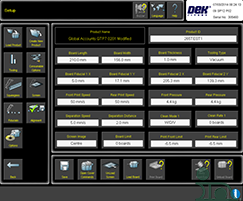
图1. 实验 打印机设置
实验中使用了厚度为4 mil的激光切割钢网 、250 mm刮刀 (带边缘护板)、无箔夹具以及横向真空支撑块。 图1展示了实验中采用的打印机设置。每种焊膏均以50mm/s的速度、4.4kg的刮刀压力、5mm/s的分离速度 以及2mm的分离距离进行印刷。仅在1小时的湿/干/真空(W/D/V)暂停期间采用了底部钢网 擦拭法。
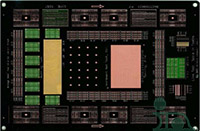
图2. 测试 车辆
选取了一款测试样品(图2),重点针对6、7、8、9、10和12mil的圆形及方形焊盘,以及0201焊盘(包括由阻焊层定义的焊盘(阻焊定义焊盘 )和未由阻焊层定义的焊盘(NSMD ))。 评估了四种粉末类型(3、4、5和6),分别用于免洗 和水洗型 助焊剂配方中。通过连续印刷20次、暂停1小时,然后再印刷6次,来测量印刷暂停响应 。 在打印完前20块印制电路板(PWBs)后,立即进行了一次W/D/V钢网 擦拭。使用Koh Young KY-3020T激光扫描系统测量钢网 打印沉积物的体积。共收集了1,386,500个数据点(焊膏沉积点)。
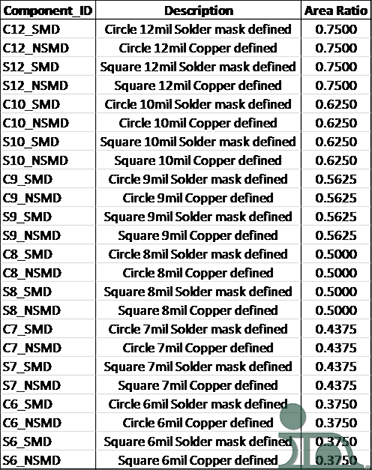
图3.焊盘标签、说明及相关面积比
图3显示了元件标识及其对应的面积比。
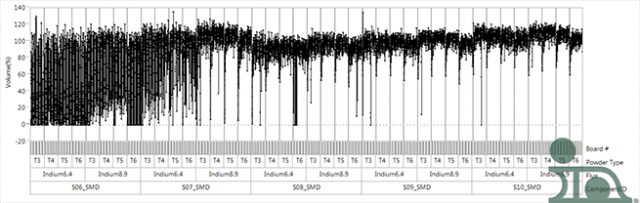
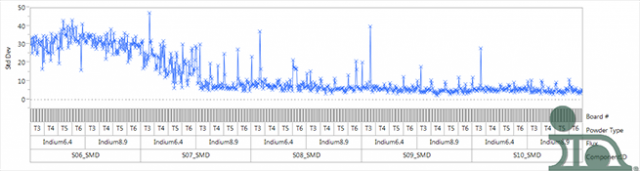
图4. 测试结果概览
Figure 4 represents a broad view of the resultant test data. The y-axis of the upper graph indicates the transfer efficiency in volume %. The bottom graph indicates the standard deviation of the process: <10% standard deviation and 100% transfer efficiency is our goal.
在调查过程中,我们排除了针对 0201 和 12mil 芯片级封装(CSP)测试焊盘的测试数据:图 4 中未显示这些数据。无论使用何种粉末和助焊剂类型,这些焊盘上的焊膏沉积效果均良好,因此未纳入进一步调查。图 4 中的数据表明,对于所有粉末类型或助焊剂载体,最小测试孔径(6mil)的印刷效果均不理想。 对于 6mil 孔径而言,面积比相当小(0.375),且结果至少可以说是不一致的。
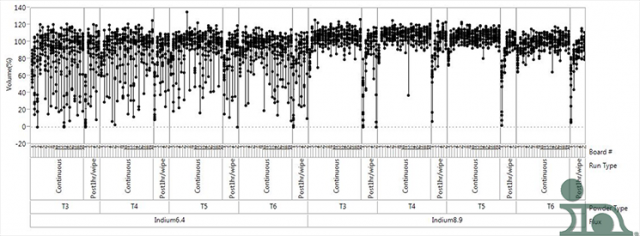
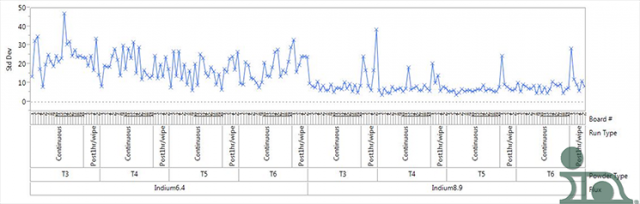
图5. 7mil正方形阻焊层定义焊盘的示例结果
Figure 4 revealed a dramatic improvement with 7mil apertures that deserved further investigation, notably between the water-soluble and no-clean flux formulations. Figure 5 shows the improvement in more detail by expanding the view of the 7mil aperture and breaking out the data before and after the 1-hour pause. The comparison is very typical when comparing no-clean and water-soluble solder pastes. Note that a standard deviation of <10%, with the exception of a few outliers was evidenced, specifically with the no-clean flux chemistry (Indium8.9). The area ratio for the 7mil aperture is 0.4375. The transfer efficiency was near the target (100%) and improved as the powder type moved toward type 6. Type 5 exhibited the best results—a narrow distribution in volume percent and low standard deviation except after first pause. It is important to note that the significant drop in transfer efficiency after the 1-hour pause was not consistent with previous experiments. For all solder pastes tested, this was attributed to a very low humidity (<10%) and had a dramatic effect on the first print after sitting on the stencil for 1 hour.
在实验中,通过采用前几篇博文中介绍的所有优化流程/指南,所获得的最佳面积比为0.4375。更细的粉末,结合阻焊层定义的焊盘、带圆角的方形孔(钢网 )以及免洗 助焊剂配方,成功提升了面积比。